Almost Timely News: 🗞️ AI and GEO Advice for Retailers for the 2026 Holiday Shopping Season (2026-05-24)

Almost Timely News: 🗞️ AI and GEO Advice for Retailers for the 2026 Holiday Shopping Season (2026-05-24)It's beginning to look a lot like forecasting season
Almost Timely News: 🗞️ AI and GEO Advice for Retailers for the 2026 Holiday Shopping Season (2026-05-24) :: View in Browser
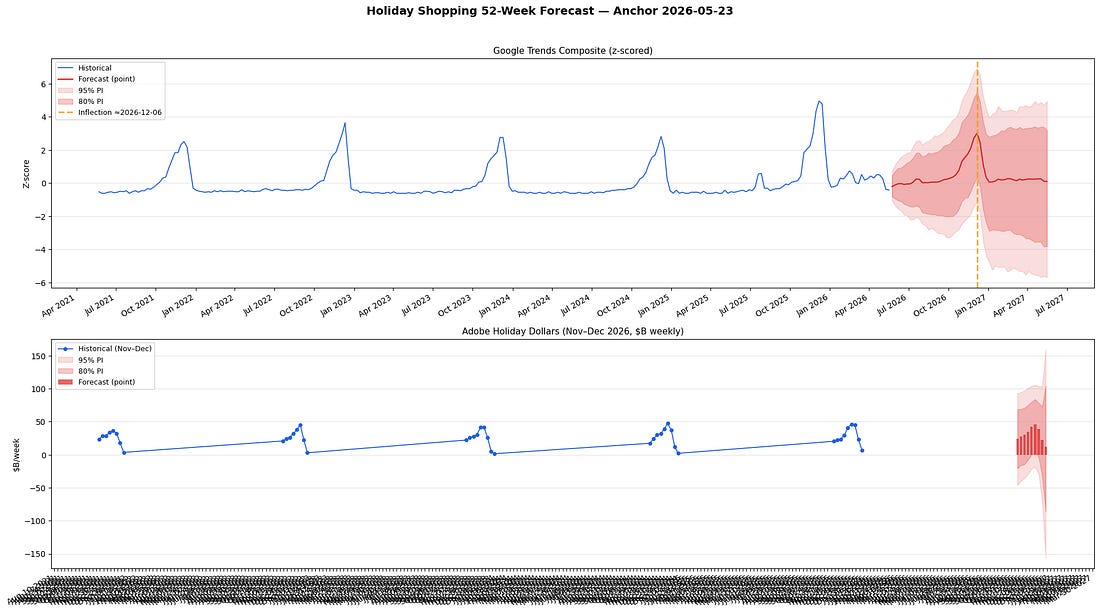
The Big PlugsNew things! Content Authenticity Statement95% of this week’s newsletter content was originated by me, the human. The chart in section 2 was generated by Claude’s Python code. Learn why this kind of disclosure is a good idea and might be required for anyone doing business in any capacity with the EU in the near future. Watch This Newsletter On YouTube 📺
Click here for the video 📺 version of this newsletter on YouTube » Click here for an MP3 audio 🎧 only version » What’s On My Mind: AI and GEO Advice for Retailers for the 2026 Holiday Shopping SeasonThis week, let’s talk about the holiday retail season. If you’re checking your phone to look at the calendar, you’re not mistaken. It’s not even June yet. But Michele asked a fascinating question to me about AI and retailers that I thought warranted a much deeper dive: “What’s one thing retailers should be doing now to prepare for the future of search this holiday season? And how should they actually approach it?“ Let’s dig into this, because it’s a more complicated question than it seems, and it hinges on what the holiday season is, what search is, and what most companies are getting wrong. Part 1: The Holiday Retail SeasonAs consumers, we think of the holiday season as mostly December. In the global north, that’s winter; in the global south, that’s summer. November and December are when B2B slows down and B2C is operating at a frenetic pace. But that’s not when the holiday season starts, not for retailers. The holiday season starts... well, started a month or so ago. Retailers have to think about inventory, and with global chaos caused by the US federal government’s attacks on Iran and the subsequent closure of major shipping lanes and disruption of the energy economy, there are many more wildcards in play. Retailers have to try figuring out what demand will be, and when consumers will be interested in what they have to offer. That’s where tools like forecasting come into play, and with generative AI, that forecasting is easier and more accessible than it’s ever been before. Let’s start with trend data. If we want to understand what’s likely to happen, and we have a fairly durable set of past history to draw from, we can use AI to do that inference. There are two catches here. First, this is classical AI - AI that’s rooted in regression analysis, math and statistics, as opposed to generative AI, which is what almost everyone else means today when they use the word AI. Second, we need data to forecast from. Some of the best free data sources come from government sources (especially boring ones that are politically neutral, like the number of air travelers through USA TSA checkpoints daily, one of my favorite travel industry datasets) or Google Trends data. Let’s say we want to know when people will start thinking about shopping for the holidays. Where might we go? We’d start with search data, because search data is durable and highly predictable. Take a look at Google Trends for trends phrases like “holiday gift guide”. These remained durable even through the pandemic, because people never stopped looking for gift ideas. You’ll see it begins its inflection roughly every September. The second thing we need to determine is whether or not the consumer is in a buying mood. That’s where things like consumer sentiment play a role, such as the University of Michigan consumer sentiment survey. When sentiment is low, people tend to buy less. The Google Trends data tells you what’s likely to happen. The consumer sentiment survey tells you the probable magnitude. Now, if you’ve never done forecasting before, the good news is that generative AI makes this easier than ever to get started. You don’t need to own any software other than an AI coding agent like Claude Code, Claude Cowork, Google Antigravity, OpenAI Codex, OpenCode, or similar, and you don’t need the smartest, most expensive model for what’s essentially commodity statistics. We’ll want to weight things like inflation as well, since life has gotten much more expensive in recent years, so we’ll get median inflation (inflation inclusive of everything) from the US Federal Reserve Bank, plus Adobe’s annual holiday shopping reports which are always excellent summaries of the season overall. Put all your data in one location and open up your AI coding tool. Here’s a good starting prompt you’ll want to adapt and improve:
I realize that’s a wall of text, but it’s easier to copy and paste, and AI will know what to do with it. Give this to your coding agent - a web-based chat LLM like ChatGPT will never, ever successfully complete this task. What we see in the forecast for 2026?
Lower dollar spend than in 2025, probably on par with 2024 or earlier, and consumers begin their searches for holiday gift ideas around the week of September 20, peaking the week of December 6. Now that we know when we need to be ready, we can dig into the search part of the question. Part 2: The Future of Search and GEO for RetailersGEO (generative engine optimization) advice is a bag of land mines and rabid, flaming gerbils at the moment, and reaching in the bag blindly for GEO advice is bad news. You’ll get bitten, burned, and blown up by a lot of GEO advice, most of which is either anecdotal or just unhinged. I won’t speak for others, but what advice I have to share is either based on what credible folks like Lily Ray, Garrett Sussman, and Rand Fishkin have found through rigorous experimentation, or what I know from reading patents, technical papers, academic papers, and studies. It’s how I put together the Trust Insights GEO 101 course. Here’s the single biggest thing I know to be true at the moment: almost all “AI visibility” tools are bullshit. There’s no polite way to say that. Here’s why. First, generative AI tools are all probabilistic. If you’ve never tried this before, ask for the kind of advice you know a stakeholder would want to be included in, from your web-based chat tool of choice. For example, “Name the top 5 vacation spots a family of four should consider in 2026” is something a destination marketer stakeholder would want to see results for. Then copy-paste that prompt into 5 brand new chats and see if the results you get are consistent in your various AI tools. Spoiler: they won’t be. Now, there’s some nuance there. If you work in a field where there are only 3 companies period, then you’ll get consistent results. But for a lot of places, there will be wild variation. Second, the biggest AI recommendation system is still Google. SparkToro and Gumshoe earlier this year showed that 93-95% of all searches are still Google, and Google AI Overviews and Google AI Mode are now the dominant features in search. This past week at Google I/O 2026, Google said AI Mode will be part of the default search experience, pushing searchers into conversations with Gemini as fast as possible. Eagle-eyed folks spotted that Google is using heavy personalization in its AI Overviews and AI Mode; Lily Ray confirmed that with a Gemini system prompt about a week ago. Garrett Sussman at SEOWeek showed that emails in your Gmail inbox, photos in your Google Photos account, and your YouTube history all affect what results you see in search. In fact, brand mentions within emails seemed, in Garrett’s year-long testing, to influence AI Overviews, even if they were in emails not from the brand itself. All this means that any tool proclaiming they know what level of visibility your brand has in AI is lying to you, period, end of story. And the more zeroes they charge you in the price, the more they are lying. Why? Because we all know from our experiences in the last 3 years that a single word’s difference in a prompt can radically change what we see. Now imagine the thousands of words of extra context that Google gets from Gmail, YouTube, Google Photos, Google Podcasts, Google Chrome browsing history, Google Ads impression data, etc. That can go into a prompt as part of its context for building you AI Overview and AI Mode responses. There is simply no way to credibly predict any of that. There is no way to know whether your ideal consumer searching for holidays gifts has a stockpile of emails from a competitor in their inbox that will weight their results in search heavily in favor of the competitor, and an AI Visibility tool claiming that your brand is more prominent will be lying to you. So what should retailers be doing, given this rather grim state of GEO tools? Follow the formula outlined by what Google’s AI - and other AI tools - all use as their backbone. Be everywhere you can be. The Trust Insights GEO 101 course teaches this in modules 2 and 3. Part 3: What To DoBased on parts 1 and 2, I should hope that what to do next is clear: you have 3 months from now until the shopping season starts to saturate whatever media channels you have with the most useful, helpful, semantically relevant content that your consumers keep in their inboxes, that your consumers watch on YouTube, that your consumers share on social media and forward to each other. There’s a catch here: it has to be the most AND the best. You can absolutely create a swamp of crap pretty easily, but Google in its most recent updates to search guidelines is specifically penalizing crap. Here’s the relevant paragraph from the guidelines: Creating non-commodity content that’s helpful, reliable, and people-first: Be sure that you’re writing non-commodity content that your readers will find helpful and reliable. Commodity content (for example, something like “7 Tips for First-Time Homebuyers”) is often based on common knowledge, which could originate from anyone, and typically adds little unique insight for readers. In contrast, non-commodity content (such as “Why We Waived the Inspection & Saved Money: A Look Inside the Sewer Line”) provides unique expert or experienced takes that go beyond common knowledge and the ordinary. Okay, so how do you do that in an age of AI? Katie Robbert and I were talking about this recently, as it goes back to the DNA of Trust Insights - the unique data only you can provide is what allows you to create non-commodity content. What data do you have that no one else - including Google - has that you can use to transform ordinary content into content that’s unique to you? Think about what I did in this newsletter, where I put a forecast for the 2026 holiday shopping season. This is unique data because no one else has run this forecast yet. Yet, by doing that, by creating new content, particularly about retailers and B2C marketers, even though I used existing content, I transmuted it in a new way that A, hopefully creates value, and B is unique and non-commodity. There’s a second catch here, as shared by many folks recently: your best content should also be difficult for AI to summarize, otherwise Google will present it in summary form to your audience and likely NOT send the searcher to you. One travel blogger made mention that his traffic is way down, and when he went to AI Overviews to see what his audience saw, Google was presenting summaries of his work with ads and mentions of his competition instead. How can you make rich, interactive content that’s difficult for Google to abstract away and summarize? A piece of content that I produced that is genuinely useful, I think, is the Trust Insights AIView software that’s available on our site for free. This is an experience. This is software that does something. It’s not just static content that Google can easily summarize. You have to participate in this content, but it provides a lot of value to you. Finally, the most valuable long term strategic play you can make is to invest the most in systems you control - your email list, your text messaging list, your direct mail list - anything where you retain control of your audience. Social media? Definitely not, at least not public social media (Xitter, Facebook, Instagram, LinkedIn, etc.). Private social media like Discord, Slack, etc. are better BUT you can still have your platform vanish if the company goes bust or kicks you off the platform after being bought by a broligarch who doesn’t like what you have to say. We know from both Lily Ray and Garrett Sussman that the Gmail inbox is a critical part of GEO for Google in personalization, so be sure you’re not only creating emails that people desperately want to open, but also want to keep in their inboxes until the holiday shopping season. For example, if I knew, as a retailer, that I wanted my products and services primed for the holiday season, I’d be thinking about what valuable content I could create that would be timely - like summer vacation ideas - but with brands, products, and services that I really want my audience to keep in mind throughout the holiday shopping season. I’d be putting up YouTube videos that were awesome or at the very least useful and entertaining every week between now and December 6 to ensure my consumers’ Google history was as littered with me as possible. Part 4: Wrapping UpMichele’s question was originally for a short quote in an upcoming article. As Blaise Pascal wrote in 1657, “The present letter is a very long one, simply because I had no leisure to make it shorter.” The answer I gave to her was a short snippet that I thought deserved more airtime than the space she was able to make for my contribution (and given how long this newsletter is, she made the correct call). If you’re a retailer, especially in B2C, this newsletter is your blueprint for what you need to do between now and mid-September when the holiday shopping season begins with consumer interest. In Adobe’s report from 2025, half of shoppers used an AI assistant of some kind in their holiday shopping, and that was before all the tech companies shoved AI into literally every product in existence. I would only expect that to increase this year, which means you have a scant few months to get your data and AI strategy rolling. Shameless plug: this is exactly the kind of work I and my company, Trust Insights do (obviously, because I needed to do it to produce this newsletter). If you want help doing this sort of analysis and planning for your company, hit up our contact form. How Was This Issue?Rate this week’s newsletter issue with a single click/tap. Your feedback over time helps me figure out what content to create for you. Here’s The UnsubscribeIt took me a while to find a convenient way to link it up, but here’s how to get to the unsubscribe. If you don’t see anything, here’s the text link to copy and paste: https://almosttimely.substack.com/action/disable_email Share With a Friend or ColleaguePlease share this newsletter with two other people. Send this URL to your friends/colleagues: https://www.christopherspenn.com/newsletter For enrolled subscribers on Substack, there are referral rewards if you refer 100, 200, or 300 other readers. Visit the Leaderboard here. ICYMI: In Case You Missed ItHere’s content from the last week in case things fell through the cracks:
On The TubesHere’s what debuted on my YouTube channel this week: My Merch ShopI’ve been adding so much stuff that I’ve decided to bundle it all in what I call a Merch Shop, because otherwise there’s literally too much to keep track of and I run out of space in my own newsletter. So welcome to the Merch Shop! Skills for Claude and Agentic AI: Books: Courses: Subscriptions: Recent TalksThese are just a few of the classes I have available over at the Trust Insights website that you can take.
Advertisement: New GEO 101 CourseWhen I talk to folks like you, being recommended by AI is one of your top marketing concerns in 2026. We’ve taken everything we’ve learned from OpenAI’s documentation, Google’s technical papers, patents, sample code, plus our years of experience in generative AI to assemble a high-impact 90-minute course on GEO 101 for Marketers. In this course, you’ll learn:
This course is meant to be used. In addition to the course itself, you’ll also receive:
And best of all, this is our most affordable course yet. GEO 101 for Marketers is USD 99 and is available today. 👉 Enroll here in GEO 101 for Marketers! Get Back To Work!Folks who post jobs in the free Analytics for Marketers Slack community may have those jobs shared here, too. If you’re looking for work, check out these recent open positions, and check out the Slack group for the comprehensive list.
Disclosure: I source these links from LinkedIn every week on the following criteria: New in the past seven days, Easy Apply on, remote roles, USA geography. How to Stay in TouchLet’s make sure we’re connected in the places it suits you best. Here’s where you can find different content:
Listen to my theme song as a new single: Social Good: Ukraine 🇺🇦 Humanitarian FundThe war to free Ukraine continues. If you’d like to support humanitarian efforts in Ukraine, the Ukrainian government has set up a special portal, United24, to help make contributing easy. The effort to free Ukraine from Russia’s illegal invasion needs your ongoing support. 👉 Donate today to the Ukraine Humanitarian Relief Fund » Events I’ll Be AtHere are the public events where I’m speaking and attending. Say hi if you’re at an event also:
There are also private events that aren’t open to the public. If you’re an event organizer, let me help your event shine. Visit my speaking page for more details. Can’t be at an event? Stop by my private Slack group instead, Analytics for Marketers. Required DisclosuresEvents with links have purchased sponsorships in this newsletter and as a result, I receive direct financial compensation for promoting them. Advertisements in this newsletter have paid to be promoted, and as a result, I receive direct financial compensation for promoting them. My company, Trust Insights, maintains business partnerships with companies including, but not limited to, Amazon, Talkwalker, MarketingProfs, Agorapulse, The Marketing AI Institute, Spin Sucks, and others. While links shared from partners are not explicit endorsements, nor do they directly financially benefit Trust Insights, a commercial relationship exists for which Trust Insights may receive indirect financial benefit, and thus I may receive indirect financial benefit from them as well. Thank YouThanks for subscribing and reading this far. I appreciate it. As always, thank you for your support, your attention, and your kindness. Please share this newsletter with two other people. See you next week, Christopher S. Penn Invite your friends and earn rewards
If you enjoy Almost Timely Newsletter, share it with your friends and earn rewards when they subscribe.
|





Comments