Almost Timely News: 🗞️ Better Vocabulary for Better AI Results (2025-11-30)
Almost Timely News: 🗞️ Better Vocabulary for Better AI Results (2025-11-30)Language models work better with better language
Almost Timely News: 🗞️ Better Vocabulary for Better AI Results (2025-11-30) :: View in Browser
The Big Plug🚨 Watch my latest keynote, How to Successfully Apply AI in Financial Aid, from MASFAA 2025. Content Authenticity Statement95% of this week’s newsletter was generated by me, the human. You will see 3 AI rendered images in the opening section by Google’s Gemini 3. Learn why this kind of disclosure is a good idea and might be required for anyone doing business in any capacity with the EU in the near future. Watch This Newsletter On YouTube 📺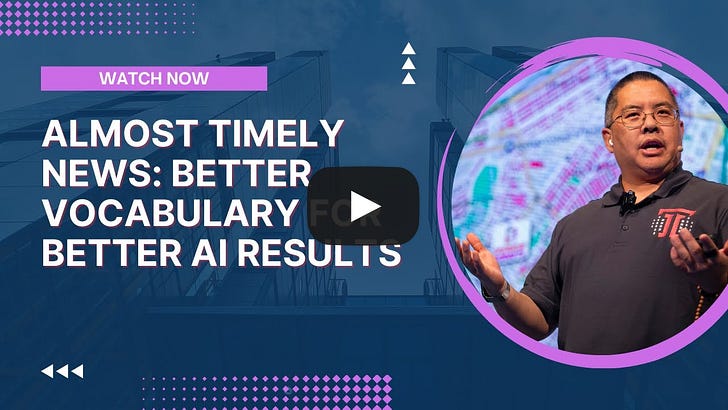 Click here for the video 📺 version of this newsletter on YouTube » Click here for an MP3 audio 🎧 only version » What’s On My Mind: Better Vocabulary for Better AI ResultsThis week, let’s talk vocabulary. Vocabulary is one of the skills that separates great users of AI from users struggling to get good results. Here’s what I mean. Large language models, by their very nature as language models, run on language. The better quality and quantity of language going in, the better the results are coming out. This fundamental principle is what sets apart good from great. Part 1: The Very Basics of Language ModelsTo understand AI and how vocabulary matters, we first have to understand how AI works at least in a simple way. This explanation is what I use to oversimplify AI. It is mathematically incorrect. It is NOT the linear algebra and calculus that makes AI models work. If you want to learn that, you can check out this interesting interactive tutorial that steps through the math of an AI model in great detail. Imagine every word has a constellation of related words around it, like a word cloud. I say “cheese” and you might think “burger”. I say “Apple” and you might say “iPhone”. All language has these relationships, these associations. On top of that, all language has predictable patterns. “God save the Queen” makes sense to us in UK English. “Queen God the save” does not, even though it’s the exact same words. Those patterns - word order, meaning, etc. - can be boiled down into statistics. Every word is related to another word, and when we start putting words together, those associations strengthen. “Cheese” and “Apple” put together have a closer association with “fondue” than they do “burger” because they co-occur more. Imagine as you type a prompt, the word clouds around each individual word start to intersect. The more words you type, the more intersections there are, until it becomes clear exactly what it is you’re writing about. The intersections get very, very specific. Conceptually, this is what’s going on under the hood at a rudimentary level - but it’s close enough to help make the rest of this newsletter make sense. AI models are all about how things relate to each other. Part 2: JargonToday’s AI models can have massive inputs as prompts. ChatGPT and Claude can take an entire business book as a prompt, 75,000 - 90,000 words. Should you do this? No. Could you do this? Yes. I always get a chuckle reading so-called AI experts on LinkedIn urging people to be concise in their prompts for daily business use. That advice was relevant in 2022 when ChatGPT came out and could handle only 3,000 words maximum in a conversation, but times have changed. As a sidebar, that advice IS still relevant if you are building AI agents and systems where you expect thousands of users to use the system. Conciseness matters at that scale because you’re paying for every word in your app’s prompts. But for the average user of ChatGPT, Gemini, or Claude who pays a flat rate per month? Conciseness isn’t nearly as important as context. Gemini can handle even more. You could, if you so chose, put the entire works of William Shakespeare as a prompt, all 800,000 words. Again, should you do that? No. Could you? Yes. So the maxim I’ve been urging people to use since 2023 is: the more relevant, specific words you use, the better your AI results will be. Jargon is your friend. Let’s talk about why. Jargon - those terms that are specific to an industry, the inside baseball language - is incredibly effective with AI because it helps language models understand the domain and context very, very quickly. If I say “paying for college”, that’s fairly generic. It could mean a lot of things in a lot of places. If I say “FAFSA”, the Free Application for Federal Student Aid published and collected by the US Government, that one word immediately conveys that we’re talking about federal student aid for college within the United States. It is incredibly specific. George Bernard Shaw once say, “Every profession is a conspiracy against the laity”. Every profession’s language, though, is the key to unlocking AI’s precision. Remember that AI models fundamentally are about how things relate to each other. If you’re using generic language, there can be a TON of related concepts that aren’t very specific, and thus the output you get from AI is… well, not specific. Take this absolutely awful prompt as an example:
That’s terrible. Useless. And the slop it will produce is equally unhelpful. Suppose you wrote:
Just that one phrase, using jargon, immediately changes the model’s understanding of what we’re doing from B2B marketing (a giant topic) to the marketing of a specific kind of industrial ball bearing. Part 3: VocabularyWith all that in mind, that brings us to the topic of vocabulary. When it comes to AI, prompts are a lot like recipes. Recipes are important, to be sure. Cooking without a recipe generally yields less good results, especially if you are cooking something you’re unfamiliar with or in a cuisine you don’t know. But the recipe is not the food. The map is not the territory. To actually cook, you need ingredients. To coax the best results out of AI, you need ingredients as well, and those ingredients are data. The good news is that AI brings a lot of its own data to the party. Today’s language models are trained on enough data that if they were printed books, they’d be a bookshelf that wraps around the equator of the planet 8-12 times. But not all that data is correct or fresh, and just because something is high probability (which is what AI generates, probabilities) doesn’t mean it’s true. Thus, the more ingredients you bring to the party, the better your results will be. Sometimes, the ingredients AI brings are enough, but if you don’t know what to ask for, you’re going to get suboptimal results. Here’s an example. My friend Ruby was attempting to have AI generate a simple tower defense video game. She got most of the prompt right in terms of the game mechanics and theme, but she lacked the vocabulary around specific terms that would have helped AI know what to do or prevent it from reinventing the wheel. Adding just this one sentence made AI behave very, very differently:
What does this cryptic sentence mean? Typescript is the language that the AI was working in, a variant of JavaScript, a very popular language on the web. A Typescript library is like a plugin or addon; Typescript libraries exist for thousands of different purposes, and because they already exist, AI knows about them. More important, AI knows what they are and what they mean, which can save enormous amounts of time because it then doesn’t have to invent its own version of that functionality. CDNJS is a free web-hosted library created by Cloudflare that lets users reference common, open source libraries totally for free. Instead of the user having to download and incorporate those libraries, they can write code that simply refers to that library of libraries and jump start their application. Phaser.io is one of the most popular game engines for Typescript and similar platforms. All sorts of game mechanics can be outsourced to Phaser, which is all stuff that AI then doesn’t have to invent from scratch. That one sentence cuts the size of code written by AI by something like 90% because it doesn’t have to reinvent the wheel for any of it, AND the existing libraries it’s referencing have been battle-tested and proven, cutting down debugging time. That is the cheat code of vocabulary. If you know the words you want to invoke, you can dramatically shift how AI works because it understands those jargon-like words and their very specific meanings. Part 4: Other Favorite VocabularyLet’s look at a few of my other favorite terms to use with AI, little vocabulary things that make a big difference.
What all these terms have in common is that they are jargon, specialized vocabulary from domains AI has seen a lot of, or are language tricks that help both humans and AI think more clearly. Many of them come from coding or similar backgrounds. Why? Because AI knows that best. Take a look at the models and tools released in the last 3 months:
Notice anything in common? AI companies are hyperfocusing on code tools and models that are great at coding. There’s no Claude Dentist. No GPT-5.1-Lawyer. No OpenAI Nurse. No Gemini Construction Assist. AI companies are going all in on software development, in part to replace developers as quickly as possible and cut their own costs. In turn, that means these tools know development and coding vocabulary better than nearly any other context. If you’re looking for words, phrases, and concepts that will generate better results for your specific prompts, consider borrowing terminology from software development if there are appropriate parallels. Here’s the question for you: what highly specific vocabulary do you know that you could bring to AI that means something in your world? Part 5: Context EngineeringVocabulary will get you better results immediately, especially if you use the jargon of your area of focus. The good news is that you know - or should know - what all that vocabulary is. If I talk about DSO, DIO, DPO, and CCC, just those four abbreviations instantly cue AI into understanding we’re talking about cash flow analysis when put together. If you want to take things to the next level, provide more data. Instead of just relying on what AI knows in its own latent knowledge, bring as much of your own data to the party as possible. If AI isn’t cooking up a great dish, the ingredients are probably at fault, not the recipe. Here’s a simple example. For those of you who have used Google’s new Nano Banana Pro image editing model, you’ve noticed it creates really incredible, highly detailed images. Images so realistic, it’s hard to tell they are AI. But there are still tells - you just need to look more closely. This is the result of models becoming smarter - as Ethan Mollick says, smarter AI makes smarter mistakes. Suppose I gave Nano Banana Pro the following prompt:
That’s a pretty decent prompt, and it encourages tool handling, the ability for AI to use tools (like web search) to fill in gaps it might otherwise have in its knowledge. Let’s see what Gemini comes up with.
Yeah, no. That’s not me. Is it close? Not really, no. Why? Because as the cliche goes, a picture is worth 10,000 words. To accurately describe me requires a lot more than just a paragraph. Even if I had the AI look at a photo of me and describe me in 12 paragraphs, it doesn’t make a huge improvement:
That’s better, but it’s still not me, even with over a thousand words of description. What happens if I provide a lot of context? What happens if I provide reference data instead? I gave it photos of the street, from Google Maps, and photos of me when I was on vacation.
That’s me. That’s also the cafe, exactly. I’ve never been there, but that’s what it looks like from Google Street View, down to the rattan chair furniture pattern. Instead of trying to use prompts (recipes), we provided better ingredients (data) along with a good recipe. The result was far more precise and desirable than what the recipe alone could do. The key takeaway here is that once recipes start showing diminishing returns, it’s time to focus on your ingredients. And if you want great results from the start, don’t start with just a recipe. Bring ingredients from the get-go. Part 6: Wrapping UpThe right vocabulary, in the right context, makes all the difference between good AI results and great AI results. There’s a good chance there are just a few words in the domain you’re working in that will dramatically change the outcome of what AI can deliver for you. Think about the shorthand that a true subject matter expert, talking to another subject matter expert, would use in their conversation. For example, two lawyers would never have to define what a case was, what a judgement was, what an amicus curiae brief was. They know all those inside baseball terms by heart, so they can speak in highly technical jargon - Shaw’s conspiracy against the laity - to communicate lots of information in a very dense format. AI understands that. AI speaks that. AI can work with that and instantly triangulate on what you’re trying to do far better with the right vocabulary. If you’re trying to do a task that you don’t have the vocabulary for, take a step back and do some homework on the vocabulary of that discipline. Once you get the lay of the land, you’ll be far more effective with far fewer words. How Was This Issue?Rate this week’s newsletter issue with a single click/tap. Your feedback over time helps me figure out what content to create for you. Here’s The UnsubscribeIt took me a while to find a convenient way to link it up, but here’s how to get to the unsubscribe. If you don’t see anything, here’s the text link to copy and paste: https://almosttimely.substack.com/action/disable_email Share With a Friend or ColleagueIf you enjoy this newsletter and want to share it with a friend/colleague, please do. Send this URL to your friend/colleague: https://www.christopherspenn.com/newsletter For enrolled subscribers on Substack, there are referral rewards if you refer 100, 200, or 300 other readers. Visit the Leaderboard here. Advertisement: The Unofficial LinkedIn Algorithm GuideIf you’re wondering whether the LinkedIn ‘algorithm’ has changed, the entire system has changed. I refreshed the Trust Insights Unofficial LinkedIn Algorithm Guide with the latest technical papers, blog posts, and data from LinkedIn Engineering. The big news is that not only has the system changed since our last version of the paper (back in May), it’s changed MASSIVELY. It behaves very differently now because there’s all new technology under the hood that’s very clever but focuses much more heavily on relevance than recency, courtesy of a custom-tuned LLM under the hood. In the updated guide, you’ll learn what the system is, how it works, and most important, what you should do with your profile, content, and engagement to align with the technical aspects of the system, derived from LinkedIn’s own engineering content. 👉 Here’s where to get it, free of financial cost (but with a form fill) ICYMI: In Case You Missed ItHere’s content from the last week in case things fell through the cracks:
On The TubesHere’s what debuted on my YouTube channel this week: Skill Up With ClassesThese are just a few of the classes I have available over at the Trust Insights website that you can take. PremiumFree
Advertisement: New AI Book!In Almost Timeless, generative AI expert Christopher Penn provides the definitive playbook. Drawing on 18 months of in-the-trenches work and insights from thousands of real-world questions, Penn distills the noise into 48 foundational principles—durable mental models that give you a more permanent, strategic understanding of this transformative technology. In this book, you will learn to:
Stop feeling overwhelmed. Start leading with confidence. By the time you finish Almost Timeless, you won’t just know what to do; you will understand why you are doing it. And in an age of constant change, that understanding is the only real competitive advantage. 👉 Order your copy of Almost Timeless: 48 Foundation Principles of Generative AI today! Get Back to WorkFolks who post jobs in the free Analytics for Marketers Slack community may have those jobs shared here, too. If you’re looking for work, check out these recent open positions, and check out the Slack group for the comprehensive list.
I don’t know if you’ve noticed this or not, but when I search for marketing jobs now, an awful lot of them have AI in the job title. That’s an indicator, if there ever was one, that this is broadly a skill set that you can’t ignore. Advertisement: New AI Strategy CourseAlmost every AI course is the same, conceptually. They show you how to prompt, how to set things up - the cooking equivalents of how to use a blender or how to cook a dish. These are foundation skills, and while they’re good and important, you know what’s missing from all of them? How to run a restaurant successfully. That’s the big miss. We’re so focused on the how that we completely lose sight of the why and the what. This is why our new course, the AI-Ready Strategist, is different. It’s not a collection of prompting techniques or a set of recipes; it’s about why we do things with AI. AI strategy has nothing to do with prompting or the shiny object of the day — it has everything to do with extracting value from AI and avoiding preventable disasters. This course is for everyone in a decision-making capacity because it answers the questions almost every AI hype artist ignores: Why are you even considering AI in the first place? What will you do with it? If your AI strategy is the equivalent of obsessing over blenders while your steakhouse goes out of business, this is the course to get you back on course. How to Stay in TouchLet’s make sure we’re connected in the places it suits you best. Here’s where you can find different content:
Listen to my theme song as a new single: Advertisement: Ukraine 🇺🇦 Humanitarian FundThe war to free Ukraine continues. If you’d like to support humanitarian efforts in Ukraine, the Ukrainian government has set up a special portal, United24, to help make contributing easy. The effort to free Ukraine from Russia’s illegal invasion needs your ongoing support. 👉 Donate today to the Ukraine Humanitarian Relief Fund » Events I’ll Be AtHere are the public events where I’m speaking and attending. Say hi if you’re at an event also:
There are also private events that aren’t open to the public. If you’re an event organizer, let me help your event shine. Visit my speaking page for more details. Can’t be at an event? Stop by my private Slack group instead, Analytics for Marketers. Required DisclosuresEvents with links have purchased sponsorships in this newsletter and as a result, I receive direct financial compensation for promoting them. Advertisements in this newsletter have paid to be promoted, and as a result, I receive direct financial compensation for promoting them. My company, Trust Insights, maintains business partnerships with companies including, but not limited to, IBM, Cisco Systems, Amazon, Talkwalker, MarketingProfs, MarketMuse, Agorapulse, Hubspot, Informa, Demandbase, The Marketing AI Institute, and others. While links shared from partners are not explicit endorsements, nor do they directly financially benefit Trust Insights, a commercial relationship exists for which Trust Insights may receive indirect financial benefit, and thus I may receive indirect financial benefit from them as well. Thank YouThanks for subscribing and reading this far. I appreciate it. As always, thank you for your support, your attention, and your kindness. See you next week, Christopher S. Penn Invite your friends and earn rewardsIf you enjoy Almost Timely Newsletter, share it with your friends and earn rewards when they subscribe.
|









Comments