Almost Timely News: 🗞️ How I Think About Building with AI (2026-02-15)
Almost Timely News: 🗞️ How I Think About Building with AI (2026-02-15)The distance to done is shrinking
Almost Timely News: 🗞️ How I Think About Building with AI (2026-02-15) :: View in Browser
The Big PlugTwo new things to try out this week: 1. Got a stuck AI project? Try out Katie’s new, free AI Readiness Assessment tool. A simple quiz to help predict project success. 2. Wonder how your website is seen by AI? Try my new, free AI View tool (limited to 10 URLs per day). It looks at your site and tells you what an AI crawler likely sees. Content Authenticity Statement95% of this week’s newsletter content was originated by me, the human. You’ll see outputs from Claude Code in the opening segment. Learn why this kind of disclosure is a good idea and might be required for anyone doing business in any capacity with the EU in the near future. Watch This Newsletter On YouTube 📺 Click here for the video 📺 version of this newsletter on YouTube » Click here for an MP3 audio 🎧 only version » What’s On My Mind: How I Think About Building with AILast month, Hubspot cofounder Dharmesh Shah wrote this very hard-hitting LinkedIn post:
I loved this quote and thanks to the magic on the LinkedIn feed algorithms, I didn’t see it until last week. But it still hit. So in the spirit of sharing, let me share how I built an absolutely ridiculous thing recently for a conference so you can see what I do and how I do it. Take anything useful for yourself, leave the rest behind. The Torrington Gopher Hole MuseumI was preparing for my keynote at the Tourism Industry Association of Alberta and wanted to showcase just how powerful AI is for even the smallest organization. But I needed an example of a very small place, the kind of place that doesn’t make headlines, that AI wouldn’t naturally recommend by itself. Ask ChatGPT or Claude where to go in Alberta and you’ll always get the high probability answers - Banff, Jasper, Calgary. And for good reason, they’re beautiful places. But they’re the places everyone else goes, so if you want a truly unique adventure, you’re probably not going to find it there. No, the low probability places can only come from insider knowledge. So my first step was to find it. A while back, I wrote a content extraction tool that uses the Reddit developer API to extract the contents of subreddits, one at a time. You can’t scrape all of Reddit, nor should you, but you can absolutely dive deep on any one community. I fired up the tool and grabbed r/Alberta, r/Calgary, r/Edmonton, and a few other relevant communities. My software ingests the subreddit up to a specific number of days, then formats it for AI use by converting it to a machine-friendly language. My recommended default these days is YAML - although JSON is great and especially useful for structured table-like data (CSV to JSON is chefs kiss) YAML is WAY more efficient in terms of space taken up. I loaded 150,000 conversations into NotebookLM and asked it a simple prompt, to find the off-the-beaten-path places that don’t make the top 10 lists for tourists, the rare places, the weird places. Places like the mining ghost town in Dorothy. As an aside, this prompt template that is in Notebook LM for this that requests the frequency is a quality check of its own. For Notebook LM, which is based on Google Gemini, if you just say give me low frequency stuff, but you don’t ask it to try to infer what those frequencies are, you’re not going to get as good a result as spelling it out and giving it an actual template. So make sure that you do that. Number 8 on the list caught my eye: the Torrington Gopher Hole Museum. It’s a museum in Torrington, Alberta, about an hour north of Calgary, and it has taxidermy stuffed gophers from the Alberta prairie dressed up in dioramas, scenes fo Alberta life. So weird. So wacky. I loved it. So I went to their website and it was… well, they’re doing the best they can with obviously very limited resources. But this was a great candidate for showcasing what AI can do. Well-funded organizations can use AI to do cool stuff, but they could also afford to do cool stuff without it. A tiny operation that doesn’t have massive resources, rich donors, and robust cash flow is much more interesting to use as a case study because the before and after is much more stark. Deciding What To BuildNow that I had an example of a great tourism-focused business, it was time to decide what to do. One of the perennial challenges of tourism-related businesses is seasonality. The Gopher Hole Museum is no exception; on their website, they say they’re closed for the season. That’s understandable - other than ski areas, Alberta’s tourism business gets quieter in the winters because the winters are often quite harsh. But bills don’t stop just because business does. One of the key questions at the Tourism Advocacy Summit was how tourism businesses that are highly seasonal could become more like year-round businesses. It’s at this point where I bring out the ultimate agentic AI framework for planning and building: Katie Robbert’s Trust Insights 5P Framework. If you’re unfamiliar, it goes like this: The 5Ps are Purpose, People, Process, Platform, and Performance.
So rather than just rush right into building a better website, we stop and think. What’s the purpose? What’s the big picture purpose. The purpose, at least from my perspective, is to find a way to drive more year-round revenue for the Gopher Hole Museum. Any earnings above zero are a positive because off season, they earn no revenue. Second, a static website improvement, even with nice design, isn’t going to help matters much. Yes, it can make the conversion experience better, but ultimately, AI is eating search. We see this most strongly in Google’s AI Overviews - they’re so rich and robust that the user needs to click through much less, which means in turn we get less traffic. If your digital presence is content that can easily be summarized by AI, then you’re not in a great place. So those are the two dual mandates restricting me: whatever I come up with has to drive revenue year-round, and it has to be resistant to AI summarization. There are additional constraints: whatever I come up with has to be lightweight. It’s evident from the website that a place like the Gopher Hole Museum does not have resources to devote to technology investments. Buying a server cluster or a cloud-hosted interactive platform isn’t in the cards. Whatever I come up with has to be lightweight and have as few dependencies as possible. And because they’re so resource constrained, it has to be zero cost, meaning no technologies that cost money on an ongoing basis other than what they have. This is where I do start engaging with AI, in Claude Code. I ask questions and ask it to brainstorm some different ways we can make something interactive. I strongly recommend having the Superpowers plugin installed and active - its brainstorming skill is wonderful. After providing it all the background material, it came up with 6 different ideas:
You can see the ideas ranged from simple to totally out there - a 3D FPS gopher game. Of these, I knew that for a simple demo and something that would be thematically on brand for the Gopher Hole Museum, #2 would be the best fit, though any of them would be solid candidates. The BuildUsing Claude Code is like having a team of developers on standby, ready to answer the call. And like a team of developers, things will go well or poorly depending on how clear your project plan is. To ensure success, you need these ingredients at a bare minimum:
If you’d like to see the full execution recipe, it’s at the end of the newsletter because it’s a couple of pages long. If you just tell AI to do a good job, it has to infer what a good job means, and depending on the tool you’re using, that could be anything from working software to just reassuring words. If you tell AI exact requirements for what constitutes success, agentic systems can run in loops until they meet the success condition. That’s the secret of what makes them so powerful - give them great instructions with clear, objective outcomes and they’ll just keep working until they hit the outcomes. The ResultHere’s the rough timeline, which occurred during my flight. I started as we crossed into Manitoba and finished up by the time we were exiting Saskatchewan, about an hour, give or take.
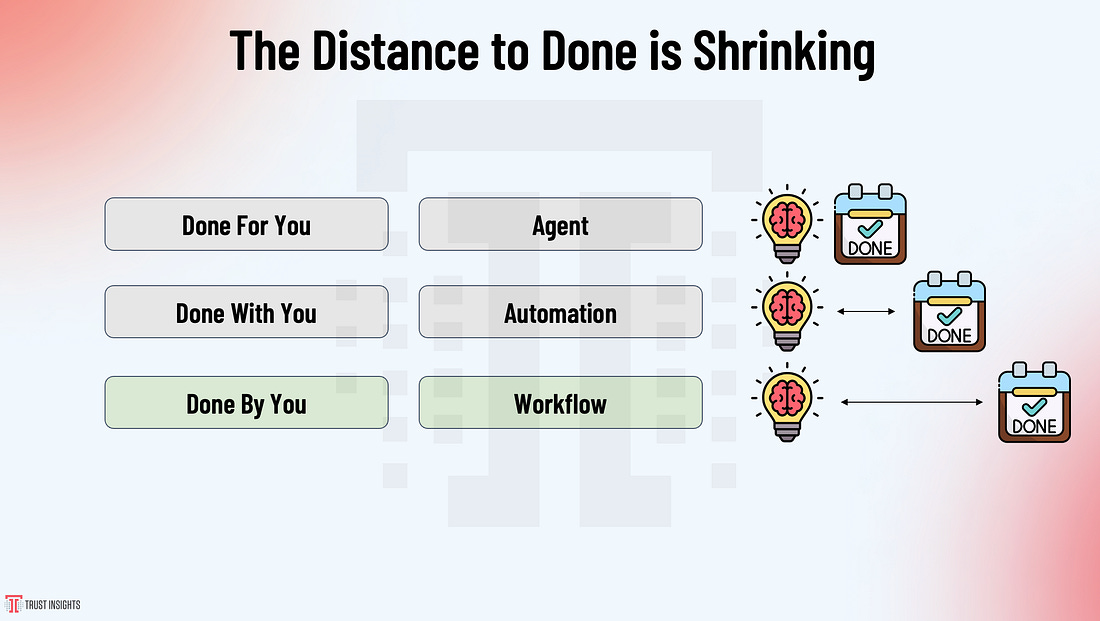
You’ll note that the planning time took about the same amount of time as the execution time. That’s generally a good sign for an AI project - the more time you spend planning, the less time you typically spend in execution (especially debugging) because the plan is the blueprint for success. In general, a good rule of thumb is that you should always spend more time planning than executing for an AI project. And if you’d like to see the proof of concept, you can visit it here. The TakeawaysI closed my keynote with this: The distance from idea to done keeps getting shorter with every generation of AI.
I look at AI in three levels, which I borrowed from product-market fit. Done by you, done with you, done for you. Done by you: when ChatGPT first rolled out three years ago, it was very capable, and we all saw the potential - but the reality is that we were copy paste robots for it. We’d paste things in, it would do things, and we’d copy the results out. We’re still the middleware there. That was good at the time, but inconvenient. Done with you: These were natural evolutions - GPTs, Gems, Claude Projects. They have some automations built in to help get things done faster, but they still had a lot of interaction required of us. Done for you: This is where we are today. This is agentic AI, where you give it the idea and it just goes, and minutes to hours later, it comes back with a result. And if your guidance was good and your plans were good, that result is a winner. There’s a fourth level, a level we’re starting to peek at now with tools like OpenClaw et. al.: done without you. As agents get ever more powerful and more integrated, as they continue to evolve their capabilities of reasoning and judgement - and today’s state of the art models do simulate judgement very well - we’ll be able to hand more off to them. For the Torrington Gopher Hole Museum, I had to do a lot of the decision-making and prep all the materials. Those tasks are interim tasks. The components exist today for the tools to do that without me, but the connective tissue to weave them all together is still being built. It will happen, and probably in months, rather than years. But that’s where things are going. Finally, I know someone’s going to read or watch or listen and say, but I don’t want to code. I don’t want to be involved in coding. How is this relevant to me? It is relevant to you because the same process of deep research, extensive planning, and then a build document works for any task in any domain, not just coding. For example, let’s say you wanted to work on your 2026 marketing strategy. You would sit down and s review with the AI tool of your choice. “Here’s what we’re doing right now and here’s the results we’re getting or are not getting”. You would then say, “let’s do some deep research to figure out what’s the state of the market right now”. Using the Trust Insights CASINO prompt framework will get you that deep research and have it be very high quality. You would then go on to say, “let’s develop a requirements document for what a great marketing strategy should be based on the deep research, based on the information provided”, the tools would go ahead and do that. And finally you would say “let’s build a build recipe based on the Trust Insights 5P framework to build the strategy, the tactics, the execution, and the measurement plans for bringing your marketing strategy to life”. Once you do that and you have those three critical components, you hand it off to an agentic system like Claude Code with the right plugins and stuff installed, and it will just go and do it and come back to you with some results for you to review. It isn’t code, it isn’t Python, it isn’t Rust or Java or any of the computer languages that you might think a tool like Claude Code would need. Under the hood, all these agentic AI systems are still language models, which means that they can do language model tasks even if they’re not explicitly coding tasks. And that is the key to making these things really work for you. Rather than interactively having to sit there and talk with it back and forth every quarter, once you develop those components and that workflow, you then build the recipe and say, just go do it and come back and review it later on. I hope this walkthrough of a case study I did shows you how I think about these tools, how I use them, and gave you some ideas for your own work that will help you get more out of the AI you’re already paying for. How Was This Issue?Rate this week’s newsletter issue with a single click/tap. Your feedback over time helps me figure out what content to create for you. Here’s The UnsubscribeIt took me a while to find a convenient way to link it up, but here’s how to get to the unsubscribe. If you don’t see anything, here’s the text link to copy and paste: https://almosttimely.substack.com/action/disable_email Share With a Friend or ColleaguePlease share this newsletter with two other people. Send this URL to your friends/colleagues: https://www.christopherspenn.com/newsletter For enrolled subscribers on Substack, there are referral rewards if you refer 100, 200, or 300 other readers. Visit the Leaderboard here. ICYMI: In Case You Missed ItHere’s content from the last week in case things fell through the cracks:
On The TubesHere’s what debuted on my YouTube channel this week: Skill Up With ClassesThese are just a few of the classes I have available over at the Trust Insights website that you can take. PremiumFree
Advertisement: New AI Book!In Almost Timeless, generative AI expert Christopher Penn provides the definitive playbook. Drawing on 18 months of in-the-trenches work and insights from thousands of real-world questions, Penn distills the noise into 48 foundational principles—durable mental models that give you a more permanent, strategic understanding of this transformative technology. In this book, you will learn to:
Stop feeling overwhelmed. Start leading with confidence. By the time you finish Almost Timeless, you won’t just know what to do; you will understand why you are doing it. And in an age of constant change, that understanding is the only real competitive advantage. 👉 Order your copy of Almost Timeless: 48 Foundation Principles of Generative AI today! Get Back To Work!Folks who post jobs in the free Analytics for Marketers Slack community may have those jobs shared here, too. If you’re looking for work, check out these recent open positions, and check out the Slack group for the comprehensive list.
Advertisement: New AI Strategy CourseAlmost every AI course is the same, conceptually. They show you how to prompt, how to set things up - the cooking equivalents of how to use a blender or how to cook a dish. These are foundation skills, and while they’re good and important, you know what’s missing from all of them? How to run a restaurant successfully. That’s the big miss. We’re so focused on the how that we completely lose sight of the why and the what. This is why our new course, the AI-Ready Strategist, is different. It’s not a collection of prompting techniques or a set of recipes; it’s about why we do things with AI. AI strategy has nothing to do with prompting or the shiny object of the day — it has everything to do with extracting value from AI and avoiding preventable disasters. This course is for everyone in a decision-making capacity because it answers the questions almost every AI hype artist ignores: Why are you even considering AI in the first place? What will you do with it? If your AI strategy is the equivalent of obsessing over blenders while your steakhouse goes out of business, this is the course to get you back on course. How to Stay in TouchLet’s make sure we’re connected in the places it suits you best. Here’s where you can find different content:
Listen to my theme song as a new single: Advertisement: Ukraine 🇺🇦 Humanitarian FundThe war to free Ukraine continues. If you’d like to support humanitarian efforts in Ukraine, the Ukrainian government has set up a special portal, United24, to help make contributing easy. The effort to free Ukraine from Russia’s illegal invasion needs your ongoing support. 👉 Donate today to the Ukraine Humanitarian Relief Fund » Events I’ll Be AtHere are the public events where I’m speaking and attending. Say hi if you’re at an event also:
There are also private events that aren’t open to the public. If you’re an event organizer, let me help your event shine. Visit my speaking page for more details. Can’t be at an event? Stop by my private Slack group instead, Analytics for Marketers. Required DisclosuresEvents with links have purchased sponsorships in this newsletter and as a result, I receive direct financial compensation for promoting them. Advertisements in this newsletter have paid to be promoted, and as a result, I receive direct financial compensation for promoting them. My company, Trust Insights, maintains business partnerships with companies including, but not limited to, IBM, Cisco Systems, Amazon, Talkwalker, MarketingProfs, MarketMuse, Agorapulse, Hubspot, Informa, Demandbase, The Marketing AI Institute, and others. While links shared from partners are not explicit endorsements, nor do they directly financially benefit Trust Insights, a commercial relationship exists for which Trust Insights may receive indirect financial benefit, and thus I may receive indirect financial benefit from them as well. Thank YouThanks for subscribing and reading this far. I appreciate it. As always, thank you for your support, your attention, and your kindness. Please share this newsletter with two other people. See you next week, Christopher S. Penn Appendix: The Build RecipeProject: Interactive Diorama Builder for the Torrington Gopher Hole Museum 1. PURPOSECore question: Can we deliver a fully functional, error-free, browser-based Gopher Diorama Builder that meets the complete specification and runs without a backend? Business context (for reference — not in scope for this build): The Torrington Gopher Hole Museum needs year-round digital engagement and revenue. The builder is the chosen solution. Business outcomes like social virality, revenue generation, and visitor conversion are downstream concerns outside the developer’s control. This recipe covers only the software build. Technical constraints governing the build:
The deliverable: A single-page browser application where users select backgrounds, drag in cartoon gophers, dress them in outfits, add props, arrange scenes on a canvas, save/load their work, export as PNG, share via URL, browse a gallery, and access a simulated print-on-demand flow. It must run error-free in Chrome, Firefox, and Safari at desktop, tablet, and mobile breakpoints. 2. PEOPLEBuild TeamRoleResponsibilityDeveloper (Builder)Architect, code, test, and deliver the complete application with 100% test coverageDesigner / IllustratorCreate or approve the SVG asset library (gophers, backgrounds, outfits, props) — can be the same person as the developer if assets are generated programmatically Reviewers / AcceptorsRoleResponsibilityMuseum Staff / BoardReview and approve creative representation of gophers and dioramas; accept final deliverableQA ReviewerVerify all tests pass, confirm 100% coverage, run through verification checklist 3. PROCESSPhase 1: Asset Creation (Batch 1 — All Independent, Run in Parallel)These four workstreams have no dependencies on each other and can be executed simultaneously. A. SVG Asset Library Create all visual assets programmatically as inline SVG:
Art direction: Illustrated/cartoon style. Warm brown fur (#A0522D base, #D2B48C belly) for gophers. Round bodies, big eyes, buck teeth. Backgrounds use flat illustration with 3–4 depth layers and a warm prairie palette. B. CSS Stylesheet (css/styles.css) Prairie-themed design system:
Typography: “Fredoka” for headings via Google Fonts CDN, system sans-serif for body. Asset panel thumbnails get rounded corners and hover scaling via GSAP. Canvas area gets an inset shadow to simulate a physical shadow box frame. Toolbar uses subtle wood-grain CSS gradients. C. Sharing/Export Module (js/sharing.js) Functions for PNG download, share URL generation (JSON → LZ-String compress → URL param), Web Share API integration with clipboard fallback, and a simulated print-on-demand order modal with pricing (postcard $4.99, magnet $6.99, framed mini print $12.99). D. Gallery Module (js/gallery.js) Loads curated sample dioramas from a static JSON file. Renders a Bootstrap card grid with polaroid-style thumbnails. Supports “Remix” (loads a gallery scene into the builder for editing) and full-size preview modal. Phase 2: Core Engine (Batch 2 — Depends on Batch 1 Asset Paths)E. Diorama Engine (js/diorama-engine.js) Konva.js-powered canvas engine managing three layers:
Core capabilities: add/remove/duplicate objects, Transformer handles for resize/rotate, z-ordering (bring forward/send backward), undo/redo stack (50 states max, full Konva JSON snapshots), scene serialization (toJSON/fromJSON), PNG export at 2x resolution, responsive scaling via fitToContainer(). F. Main App Logic (js/app.js) Alpine.js data store managing all UI state: active tab selection, builder/gallery/myDioramas view switching, first-time tutorial overlay, properties panel binding (opacity, flip H/V, lock), saved dioramas via localforage, and share link detection on page load (?d= parameter). Phase 3: Assembly (Batch 3 — Depends on Batch 2)G. index.html — Main Page Single-page app with three-column layout: asset panel (left, tabbed: backgrounds/gophers/outfits/props), Konva canvas (center, 800×600), properties panel (right). Toolbar across top (undo, redo, delete, duplicate, z-order, zoom, grid). Bottom bar with save, download, share, order print, gallery, visit museum, and donate buttons. Responsive behavior: tablet collapses left panel to icon rail; mobile uses bottom sheet drawer for assets and floating action buttons for toolbar. H. Gallery Data (data/gallery.json) 4–6 pre-populated sample dioramas created by placing assets programmatically. Each entry includes title, author, base64 thumbnail, and full Konva scene JSON. Phase 4: Integration & Polish (Batch 4)I. Welcome Tutorial 4-step GSAP-animated overlay: welcome with waving gopher, “pick a scene” arrow, “add gophers and dress them up” arrow, “share your creation” arrow. Auto-advances every 3 seconds or on click. Skip button in corner. Completion stored in localStorage. J. Testing & Verification Run through the full verification checklist and confirm 100% test coverage (see Performance section below). 4. PLATFORMTech Stack (All via CDN — Zero Build Tools, Zero Cost)LibraryVersionPurposeCDN URLKonva.js10.0.2Canvas rendering, drag-drop, layers, Transformer handles, JSON serializationcdnjs.cloudflare.com/ajax/libs/konva/10.0.2/konva.min.jsAlpine.js3.15.0Reactive UI for panels/toolbars (15KB, no build step)cdnjs.cloudflare.com/ajax/libs/alpinejs/3.15.0/cdn.min.jsGSAP3.13.0Animations, transitions, MorphSVG, DrawSVG (now 100% free incl. all plugins)cdnjs.cloudflare.com/ajax/libs/gsap/3.13.0/gsap.min.jslocalforage1.10.0Client-side IndexedDB storage with localStorage fallbackcdnjs.cloudflare.com/ajax/libs/localforage/1.10.0/localforage.min.jsLZ-String1.5.0URL compression for shareable linkscdnjs.cloudflare.com/ajax/libs/lz-string/1.5.0/lz-string.min.jsBootstrap5.3.8CSS layout frameworkcdnjs.cloudflare.com/ajax/libs/bootstrap/5.3.8/css/bootstrap.min.cssBootstrap Icons1.11.0Icon set for toolbar buttonscdn.jsdelivr.net/npm/bootstrap-icons@1.11.0/font/bootstrap-icons.css Why Konva.js over alternatives (evaluated Feb 2026):
Hosting: Any static hosting — museum’s existing web host, GitHub Pages, or even direct file:// access. No server required. Print-on-demand integration (Gelato API) is a future concern outside this build scope. File Structure5. PERFORMANCEPerformance for this build is defined strictly as: does the software work, is it error-free, and is it fully tested? Testing Requirements (Non-Negotiable)RequirementTargetPass/FailUnit tests100% pass rateAny failure = build failureEnd-to-end (E2E) tests100% pass rateAny failure = build failureTest coverage100% code coverageAnything less than 100% = build failureRuntime errorsZero errors in browser consoleAny uncaught error = build failure All modules (diorama-engine.js, app.js, sharing.js, gallery.js) must have complete unit test suites covering every function, branch, and edge case. E2E tests must validate every user workflow end-to-end: asset loading → drag-drop → property editing → save/load → export → share → gallery browse → remix. No code ships without 100% coverage confirmed. Functional Verification ChecklistEvery item must pass. Any failure is a build failure.
Bottom LineThe build succeeds when every feature works, every test passes, and there are zero runtime errors. 100% unit test pass rate, 100% E2E test pass rate, 100% code coverage, and a clean browser console across Chrome, Firefox, and Safari at all three breakpoints. If any of those conditions are not met, the build has failed. Invite your friends and earn rewardsIf you enjoy Almost Timely Newsletter, share it with your friends and earn rewards when they subscribe.
|






Comments