Almost Timely News: 🗞️ The Five Levels of AI Enablement (2026-03-22)
Almost Timely News: 🗞️ The Five Levels of AI Enablement (2026-03-22)Wherever you are, start climbing
Almost Timely News: 🗞️ The Five Levels of AI Enablement (2026-03-22) :: View in Browser
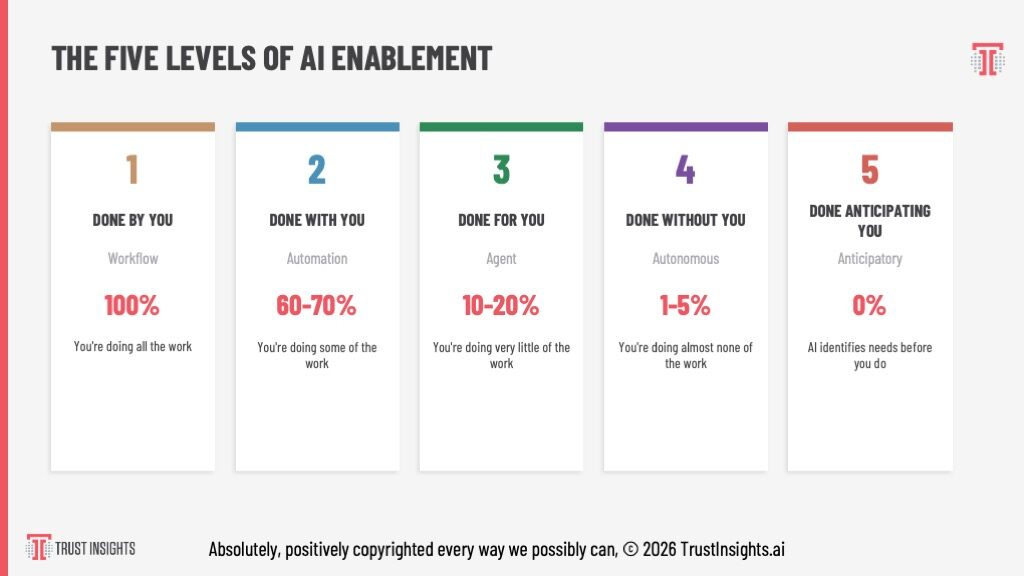
The Big Plug👉 I’ve got a new course! GEO 101 for Marketers. 👉 Just updated! The Unofficial LinkedIn Algorithm Guide, March 2026, now with new information straight from LinkedIn! Content Authenticity Statement100% of this week’s newsletter content was originated by me, the human. It was recorded first, then transcribed and cleaned up by Claude Opus 4.6. Learn why this kind of disclosure is a good idea and might be required for anyone doing business in any capacity with the EU in the near future. Watch This Newsletter On YouTube 📺 Click here for the video 📺 version of this newsletter on YouTube » Click here for an MP3 audio 🎧 only version » What’s On My Mind: The Five Levels of AI EnablementWhat’s on my mind this week? The five levels of AI enablement. This is something that has been banging around in my head for a while, and I want to try and get it out of my head and into some kind of written form. This all started a couple of years ago with my friend Brooke Sellas, who runs B Squared Media. Their thing was always done-for-you social media marketing; they now do customer experience. If you need an agency to help you with digital customer experience, they’re a terrific agency. But Brooke’s thing was always done for you. And I was like, well, what else is there? The other was done by you - you do the work. And so I was thinking to myself, well, if done by you and done for you exist, that seems like the equivalent of going out to eat at a restaurant or staying home and making something from scratch. So there’s got to be a middle ground. And the middle ground, of course, is done with you. That’s where you have - in food-analogy land - things like HelloFresh and Blue Apron and those meal delivery kits. The box arrives at your door, filled with refrigerated cooler packs and things. You unpack it, everything’s already pre-cut and pre-measured. You still have to cook it, but the process of preparation is largely done. For a while, that’s been product-market fit: done by you, done with you, done for you. Done by you, you do all the work. Done with you, you do some of the work. Done for you, you do none of the work. Part of product-market fit - and I’ve advised this to people for years - is that you have to have offerings at every level. Done by you is the lowest cost. You read a book like my book Almost Timeless. It’s a very low investment - I think it’s still $29 - but you have to do all the work. Done with you are things like apps, add-ons, and courses where a lot more has been prepared for you. And then done for you is you hire Trust Insights to go do the thing for you. Same with food: done by you, you cook from scratch - lowest cost, most labor. Meal kit, less labor, more cost. Done for you, no labor, highest cost. And so I started to apply this to AI. Part 1: Product Market Fit and AIIf we think about it, AI has kind of gone through these stages. In the beginning - 2023, right? ChatGPT came out in the fall of 2022, became popular in 2023 - when you’re sitting in front of ChatGPT prompting, that is the lowest possible level. In the five levels of AI enablement, that’s done by you. You sit down with ChatGPT and you’re like, hey, ChatGPT, do this thing, write me this blog post. Traditional, classic. Everybody has done that in some capacity. That’s the lowest level of this product-market fit framework. The second level up is things like GPTs, or Gems, or Projects. This came about in 2023 and 2024. GPTs and Gems are like mini apps inside of these tools that allow you to have some of the process baked in. I have a recipe maker Gem in Gemini that has all the rules about what I think is important in recipes, and it works great. I still have to do a fair amount of the work, but it has all the logic and all the prompts pre-built in it. I can just say, hey, I need a recipe for a whole wheat pancake mix, and it goes off and does that thing and hands it back to me. I still have to go make the pancakes. That’s the second level. The third level is where we get into agentic AI and the done-for-you model - and this is where we are starting to evolve. Here’s the full framework, absolutely, positively copyrighted to Trust Insights every way we can:
Done by you. Done with you. Done for you. Done without you. Done anticipating you. Five levels. Let me walk through each one. Part 2: Mapping AI to Product Market FitLevel 1: Done By You This is pure level one. You chat with Claude or Gemini or ChatGPT, you’re doing all the work, lowest cost - $20 a month. You have access to the tools. This is what everybody knows. Here’s the problem with this level. It saves you time and gives you some capabilities, for sure - not saying it doesn’t. But when you hear people say, “I haven’t seen the ROI of AI,” it’s because they’re stuck at this level. Everybody’s got ChatGPT and they’re like, I don’t know what to use this for. This is all foundational. Learning how to prompt, learning how to talk to the systems, learning their ins and outs and their weaknesses, learning how to provide good data - because the more data you give, the less they hallucinate. This is level one. This is the base, this is the foundation. You have to learn this stuff first. But you can’t stay here. This is not the zone of productivity. About 75 to 80 percent - maybe more - of people are at level one. Level 2: Done With You GPTs, Gems, Projects. You’re doing about half the work; the tool is doing a little more than half. But if you’re good at building Gems and GPTs - especially distributing them inside your company - you start to see more standardization. If you have a sales playbook Gem or a sales email GPT distributed among your team, everybody’s on the same page, literally. There’s still a fair amount of work: copy this record in from the CRM, do this, spit out the thing, and then we can make a good pitch. But this is sensible. This is an evolution. This is not reinventing the wheel every single time, which a lot of people do. A lot of people are still copying and pasting, and you want to have some things pre-baked. About 10 percent of people are at level two. Level 3: Done For You Level three is where we start to talk about agentic AI. These are tools like Claude Code, Claude Cowork - which is everybody’s darling right now, soon to be Microsoft Co-Pilot Cowork as well, because Microsoft just licensed it - and OpenAI Codex, Google Antigravity. I did a demo the other day for a client using Codex, having Codex take control of their browser and walk them through an audit. These are tools where you’re not prompting individually anymore. You’re now handing off a requirements document, a spec, a project plan - something that follows, for example, the 5P Framework by Trust Insights: purpose, people, process, platform, performance. It’s a fully written-out plan that you hand, like a project manager to a team member, and they just go off and do it. My CEO and co-founder Katie has been using Claude Cowork a ton - saying, here’s this page, and here’s our ideal customer, rewrite this web page on our website. And because she gives it access to Chrome, Claude’s not saying anymore, “Oh, be my copy-paste monkey, Katie, and copy and paste this here and here.” It just takes control of the browser, just does it for her, which is fantastic to watch. This is where you get away from being the copy-paste monkey and into execution. You say to a system like Cowork: here’s a transcript of a YouTube video I just did, turn it into a slide deck. And it reasons through it - particularly if you give it standards as part of a good project plan - and it can go off and do those things. There is a lot of value to be extracted here. A lot of time savings, a lot of innovation that can be done. For example, I have a massive sales playbook as part of my work at Trust Insights. It’s like a 300-page sales playbook of everything we need to know to sell Trust Insights products and services - ideal customer profiles, sales tactics, objection handling, all the works. I can literally just drop that into a system like Claude Cowork with a landing page and say: rearrange this landing page to follow the best practices in this. I was also doing this the other day for a client. I had 230 academic papers on educational design - on how to create great educational materials for students - and I told Claude Code: here’s the spec derived from these academic papers. Here are the background papers. Write me a sixth-grade math textbook, start to finish. Write me the textbook, write me the workbook, write me the teacher’s guide - and the teacher’s guide has to have lesson plans and all this stuff. And sure enough, 92 minutes later, I have a full textbook for sixth-grade math that fits Common Core. I have the accompanying workbook and a teacher’s guide with lesson plans and everything. I did not have to keep prompting it. No “now let’s do page six, now let’s do page seven.” It was entirely self-contained. It went off, it did the thing, and it came back. This is where about five percent of people are now, but those five percent are seeing crazy value. If I had to say where you need to be in March of 2026, you need to be at level three today. You have to do what you can to get here - to get to using these tools and get away from level one. Get away from “I’m chatting with ChatGPT, I’m the copy-paste monkey.” We have got to get away from that and get to level three. Part 3: Introducing Level 4What occurred to me as we’re talking about these three levels of product-market fit is that there are two more levels - two more levels on top of this. Done by you, done with you, done for you. What’s next? Done without you. This is where just the nerds are hanging out right now. The most prominent tool people have heard of is called OpenClaw, which used to be called Multbot, and before that ClaudeBot. These are fully - mostly - autonomous systems. This is a Docker container or a Mac Mini or a Linux box that you run a full AI agent on. You connect it to everything that’s valuable that you want to connect to, and then you just pick up your phone and text it, or message it on Telegram or Discord or Slack, and you give it high-level objectives, and it just kind of does stuff without you. Andrej Karpathy created a system called auto research. He said: hey, I want you to go out and actually do this research, do a meta-analysis, do a synthesis, and then write me a new paper. It’s like a two-paragraph thing - basically the intent and the success measures - and then the system goes, sets up its own agents, sets up its own processes, sets up its own execution plan, does it, comes back and says, here’s the thing that you asked for. That’s done without you. Because with something like Claude Cowork, there’s still a human in the loop. There’s still the ability for a person to say, oh wait, you need these logos. Once you get to level four and you’re using a system like OpenClaw, you’re not in the loop anymore. You’ve left the room - you’ve given it the initial stuff and you’re gone. That’s level four. About one percent of AI folks are at this level, but you can see where there is enormous value to be had here. The more autonomous a system is, the more value it can create on its own. You might say: hey, I’ve got this idea for a video game, I want it to work like this, it needs to accept payments, it needs to be on the web, it’s got to have a mobile app. You give it the requirements and say, go do it, and don’t come back until you’ve successfully met my objectives. And it will continue to try. It may take some time, it may take a few days of heavy crunching, and you’ll probably get a decently sized bill from Anthropic or Google. But the systems start to build the thing. This is also where something important is happening inside the AI industry itself. The company Minimax just released the Minimax M2.7 model earlier this week - six weeks after M2.5. And when you look at how they shipped a better model in six weeks, they said Minimax M2.7: 40% of it was written by itself. So it wrote itself. Their goal is to get that to 50, 60, 70, 80, 90, 100 percent, so that the tools evolve to doing the work for them. Anything you can think of where you would want to deploy a team - if you would hire an agency to do it - this is the replacement for that. Give that some thought. If you would hire an agency to do it, and you now have these fully autonomous AI systems, what does that mean for agencies? If you would hire an SEO agency in the past, and you now have something like NemoClaw - which is NVIDIA’s OpenClaw implementation - you say: here’s my website, here’s my Google Search Console data, here’s what these different measures mean. In a sandbox, not on production please, optimize the heck out of my website until it hits these success metrics. It might do that. Or you might say: we are pivoting from solution selling to insight selling. Here is all my sales material. Update it, and just tell me when it’s done. And it does it. As long as you provide the right data and success measures that a machine can optimize against, it’s going to do it. Your effort on this is minimal, and you’re going to create enormous economic value. This will also imperil a lot of businesses - particularly anything that’s a subcontractor, anything that’s a contractor, anything that’s an agency. This type of technology poses a mortal peril to your business because as the models get smarter and the harnesses get better, they are more capable. You might say: go write me an NDA that complies with federal law in the USA plus state law in Massachusetts. Build me the NDA and an explanation of what choices you made and how it complies with the law. And it will go do it. In the same way that I had Claude Code build me a textbook - where I did the deep research and provided the academic papers - at level four, that research step would be part of the process too. I would say: you’re going to do the research, you’re going to pull all the academic papers that are credible on this for the last 15 years. Then once you’ve done the research, you’re going to build the textbook, the student workbook, and the lesson plans. Off you go. And two days later it may be done. Done without you. Part 4: Introducing Level 5However, there’s a fifth level. The fifth level is done anticipating you. This doesn’t exist yet, but the component technologies to make it happen do exist. So this is near term. I am placing a bet that a system will be available before end of year 2026 that implements this. What this is is a combination of today’s agentic harnesses plus persistent memory. Persistent memory is the big unlock for AI right now. Every time you start Claude Code, Claude Cowork, Codex, whatever, it has no memory of what you’ve done previously. And that’s not a bad thing necessarily, but it is sometimes a pain if you’re trying to get stuff done. Like, hey, let’s update this website. And you’re like, oh, I have to invoke the skill again, I have to tell it what the website is again. Wouldn’t it be nice to say, hey, remember that web page that we optimized last week? Why don’t you remember what we did last week and do the exact same thing? In a persistent memory system, the AI agent would know that, would be able to pull that up. But more importantly, because it’s an always-on system, it could also say: hey, last week you had me updating these web pages. Why don’t I just do the others for you? You left off here - why don’t I just do this for you? Parents will understand this. It’s like your kid coming to you and saying, hey, look at this thing I made. You didn’t ask for it, but it’s nice. You liked it, right? That’s essentially what this level of AI looks like. An AI system that has memory embedded in it will look at the past and say: hey, Chris, it looks like you’re building sales playbooks. Why don’t I build you a new one based on this new finding that just came out? Because I’m also paying attention to news feeds and data feeds, and I saw this thing - I can recommend it. Or: hey, Chris, it looks like last year at this time you rebalanced your retirement portfolio. I just got 22 different things in my news feed from world events. Would you like me to rebalance your portfolio like this? Or if I had given it permission in advance, it might just do it. This is AI that identifies needs before you do, knows what you want, and delivers it. The underpinnings - the component technologies - to make this work exist today. There are systems like Open Viking from ByteDance, which is a persistent memory system. Serena MCP, which is used a lot by coders, is a persistent memory system. There are so many of these systems that exist, but they’re not fully baked into the autonomous frameworks in a way that is predictive yet. It is a very short leap of the imagination to say we get to this based on the technologies that exist right now. When level five systems become generally available, the gulf between AI-fluent people and AI laggards is going to be unimaginably large. Today, a business that is not AI-enabled can compete to some degree still with a business that is, because review processes can add speed bumps for AI-enabled businesses. You can create 10,000 pieces of content, but somebody’s still got to review it. Those speed bumps are getting smaller and smaller and going away as agentic tools are capable of doing more and more review on their own. When level five systems come out, the ability for a company to embrace it and use it - whoever gets there first in their field or niche - is going to eat the rest of the field. And this is not a budget thing. This is not the well-heeled company that will do this, because there are so many great models out there like Minimax M2.7 that are dirt cheap. Nemotron from NVIDIA, Mistral Small 4 from Mistral - pennies on the dollar compared to what you pay for Claude or Gemini or whatever, and they’re built for agents. It is not a budget thing that will determine the winners or losers here. It is an initiative thing, it is a risk-taking thing. Part 5: What Should We Do?Indigo in Analytics for Marketers asked a very sensible question: “How do we share this with our teams and not scare them to death?” You have to be honest. You have to be honest with people and say: this is where the technology is, this is where the technology is going. More and more is possible to be automated.
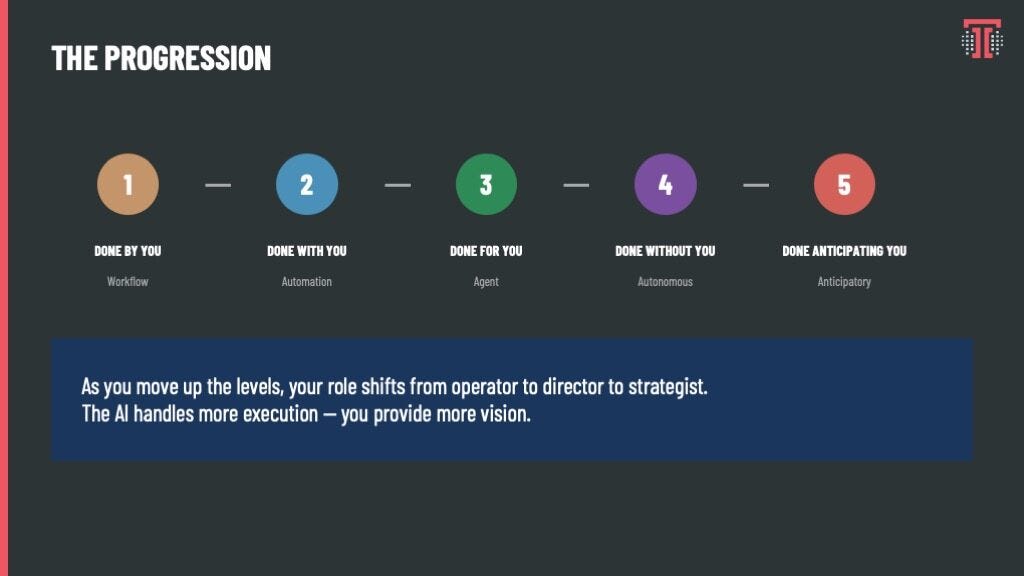
One of the things I’ve said in the past is you don’t have to give up the things you love doing. For sure, give up the things you hate doing. Hey, autonomous system, please do my expense reports for me. I never want to see them again. That’s like utopia. But even for the things you love doing, you have to think about what it means when the machines can do it better than you - whether it’s writing or strategy or whatever. You have to have that honest conversation with yourself: what is unique about your perspective? Because the tools, the models, all this stuff have the knowledge necessary to operate at PhD levels for everything. What is your secret sauce - your secret herbs and spices - that makes your perspective different and valuable? Because if you are a level-zero company and you leapfrog to level three, you’re starting off with a fairly generic data set. It’s not customized. Whereas if you’ve been in the field a while and you know what makes you special as a human being, you can inject that into here. By the way - this whole deck was created by Claude. I had a LinkedIn post and Claude turned it into - ta-da - a slide deck. I actually didn’t ask for a slide deck. It just decided I needed one. And you know what? Yeah, I kind of did. Think about it - it’s kind of almost level five. But you have to figure out what is your secret sauce that you bring that is uniquely human and that machines are going to have a hard time replicating. Things like your voice, your personality. How do you build that into the machines so that you can enjoy the increase in speed and quality, and the reduction in cost, that the machines deliver? First is to figure out your secret sauce - what is uniquely yours that the machines can amplify but not replace. Second is to think about the value chain. This is something that very few people think about, and I wish more would. The value chain goes from commodity to brand to service to experience to transformation. If you make industrial ball bearings, that’s a commodity product. If you put the ball bearings of five different companies in front of me that were all the same size, I will be like, I can’t tell the difference between any of these - I’ll buy the cheapest one. You’ve got to figure out how to transform your commodity into a brand that people are willing to pay a premium for. People will pay a premium for an Apple device. People will pay a premium to hire Christopher Penn as a speaker. I hope. How do you level up? And then from there, if you’re in product, how do you move that to a service? You can get an IKEA cabinet - it’s a flat-pack, a pile of parts. You can hire a service to put this together for you. You can hire TaskRabbit or whatever. So IKEA the product becomes IKEA the product wrapped inside the TaskRabbit service, with the outcome being a cabinet. Above service is experience, where the service is so good that it becomes an experience unto itself. Disney theme parks are a great example. An amusement park is a service. A Disney park is an experience. If you can afford it, it is literally magical. You get to the airport, you check in, your bags get tagged with special Disney bag tags, they vanish and they magically reappear at your hotel room. You don’t have to worry about anything. You get on the special bus, you get the special wristband, you show up and things just happen in a completely frictionless way. It’s like being in a place where everything you could possibly want is taken care of. And then on top of that is transformation, where an experience you have is so magical that it transforms who you are. It changes you as a human being. You can go to a music concert - which is an experience, especially if it’s a musician you like - and the biggest shows, like a Taylor Swift concert, you have this transformation into something else. You go to your favorite motivational speaker and you walk out a different person. That’s the value chain. Everybody right now in the knowledge workspace is largely still producing commodities. Here’s an NDA. Is this NDA any better than the one I get from this other lawyer over here? It shouldn’t be, because there are all kinds of legal requirements. So what does a lawyer do to up-level the commodity into a service, into a branded product, into an experience, into a transformation? It may not be possible to get all the way there from NDA services, but you can certainly get to a high level of service. If you are a knowledge worker doing things like creating strategy or content or email marketing or music or art or photography, your output today is a commodity. At the very least, you have to figure out how to become a brand so that people ask for your work specifically because they like your perspective on it. Because AI can very credibly create very good generic commodity content. Go to a system like Suno - it creates really good commodity music, perfectly good enough for elevator music or background music on a YouTube video. What can you do to raise the value chain? And by the way, agentic AI is really good at helping with this, because you give it a value chain framework, give it your product and service, and say: how do I elevate all of this into something better? Give it your ideal customer profiles and say: re-engineer my business for me, up-leveling it to a service or an experience. The technology is going to keep expanding to take away more of the stuff at the bottom. All the commodity stuff has effectively been eaten - it’s just that people have not caught on to it yet. Some of the branded stuff is going to get eaten. Some of the service stuff is going to get eaten as agents become more and more autonomous. That leaves you with experience and transformation, because right now the tools don’t have those abilities and are probably not going to anytime real soon. How do you create an experience? How do you create a transformation in somebody working with you - so that even if there’s a gazillion and a half copycats who all have their own OpenClaw servers generating substantially similar commodity outputs - the way that you work with those outputs to create that experience for somebody is what’s going to set you apart. It already is massive, but it’s going to be even more massive, because the tools are getting to a level of capability that goes from - I always used to say, treat it like the world’s smartest, most forgetful intern - and once we get persistent memory, it’s not forgetful anymore. And already the models in 2025 became PhD level in almost every field. Today they’re above that by a considerable amount. So it is the world’s smartest, most capable agency in anything. You want a drop-in replacement for McKinsey? You can build it. What would be a six-to-nine-million-dollar project you can do in six to nine hours for six to nine dollars of API calls... that’s a lot of sixty-nines. The companies who are willing to invest heavily in people and innovation are going to eat alive everybody else in that field, and the window for taking advantage of this is going to be very short. Also: if you are at level one today, as tools like Claude Cowork evolve, you can kind of skip to level three or even to level four - and you don’t have to have gone through level two, because something like Claude Cowork or OpenAI Codex just bypasses those GPTs and Gems. They’re obsolete, right? To be clear, they’re still useful to a lot of people. But from a technological perspective, they are obsolete now. If you are at level one, you can leapfrog to level three, perhaps level four, depending on the use case. If you are not at level one at all - if you are resistant, or your company is resistant, or your organization or your leaders are resistant - everybody who is in the field and willing to invest and take some risks is going to jump to level four without you. And the gulf between zero and four is massive. The value created is massive. And your ability to catch up will be harder and harder because autonomous systems, by nature, can self-improve. A company that’s early - that says I am all in on NemoClaw - is going to have systems that self-improve and be better at contracts, better at sales, better at finance and reconciliation, better at all those things. And those people who get these systems turned on sooner will have more training data, which means they will be able to adapt faster to changing conditions, be more agile. And the laggards who are at level zero never catch up. Because even if you said, all right, fine, we’re going to buy NemoClaw, we’re going to drop a server and we’re ready to go - this other company that’s been at level four for three months, six months, twelve months has got all the data. They’ve got all the training data, they’ve got all the examples, they’ve got the scars to get the stars. They’re able to run those systems well and work out all the gotchas. And while the level-zero company is working out the gotchas, the level-four company is probably moving into level five. I believe that level five is where the systems are going, and they’re going soon. We’re not talking three years from now. We’re talking end of this calendar year. Part 6: Wrapping UpThe logical thing to say now is: how do I get started? Trust Insights has tons of courses and things like that, and we’re going to have more. I’m going to be doing one on Agentic 101 relatively soon, because we need to get this content out there so that people have it and can catch up if they are still at level one or level two. You’ve got to get to a minimum of level three. Katie is going to be doing some stuff as well, because she has been enormously successful with that level-three work as a non-technical person, and her perspective is so valuable. Because a lot of people say, yeah, Chris, that’s cool that you did that, but that’s you. Katie’s not a techie. Katie’s not going to fire up Python 3.12 anytime soon. Katie’s not going to be doing Docker containers and all that stuff. That’s not going to happen. And yet she’s still getting tremendous value out of agentic AI. So more to come on that. But that’s where my head is at this week: this evolution - done by you, done with you, done for you, done without you, done anticipating you - is where AI is going, and we need to be ready. Shameless plug: want help moving your organization up a level? My company, Trust Insights, does exactly that. Click here to learn how. How Was This Issue?Rate this week’s newsletter issue with a single click/tap. Your feedback over time helps me figure out what content to create for you. Here’s The UnsubscribeIt took me a while to find a convenient way to link it up, but here’s how to get to the unsubscribe. If you don’t see anything, here’s the text link to copy and paste: https://almosttimely.substack.com/action/disable_email Share With a Friend or ColleaguePlease share this newsletter with two other people. Send this URL to your friends/colleagues: https://www.christopherspenn.com/newsletter For enrolled subscribers on Substack, there are referral rewards if you refer 100, 200, or 300 other readers. Visit the Leaderboard here. ICYMI: In Case You Missed ItHere’s content from the last week in case things fell through the cracks:
On The TubesHere’s what debuted on my YouTube channel this week: Skill Up With ClassesThese are just a few of the classes I have available over at the Trust Insights website that you can take. PremiumFree
Advertisement: New GEO 101 CourseWhen I talk to folks like you, being recommended by AI is one of your top marketing concerns in 2026. We’ve taken everything we’ve learned from OpenAI’s documentation, Google’s technical papers, patents, sample code, plus our years of experience in generative AI to assemble a high-impact 90-minute course on GEO 101 for Marketers. In this course, you’ll learn:
This course is meant to be used. In addition to the course itself, you’ll also receive:
And best of all, this is our most affordable course yet. GEO 101 for Marketers is USD 99 and is available today. 👉 Enroll here in GEO 101 for Marketers! Get Back To Work!Folks who post jobs in the free Analytics for Marketers Slack community may have those jobs shared here, too. If you’re looking for work, check out these recent open positions, and check out the Slack group for the comprehensive list. Advertisement: My AI Book!In Almost Timeless, generative AI expert Christopher Penn provides the definitive playbook. Drawing on 18 months of in-the-trenches work and insights from thousands of real-world questions, Penn distills the noise into 48 foundational principles-durable mental models that give you a more permanent, strategic understanding of this transformative technology. In this book, you will learn to:
Stop feeling overwhelmed. Start leading with confidence. By the time you finish Almost Timeless, you won’t just know what to do; you will understand why you are doing it. And in an age of constant change, that understanding is the only real competitive advantage. 👉 Order your copy of Almost Timeless: 48 Foundation Principles of Generative AI today! How to Stay in TouchLet’s make sure we’re connected in the places it suits you best. Here’s where you can find different content:
Listen to my theme song as a new single: Advertisement: Ukraine 🇺🇦 Humanitarian FundThe war to free Ukraine continues. If you’d like to support humanitarian efforts in Ukraine, the Ukrainian government has set up a special portal, United24, to help make contributing easy. The effort to free Ukraine from Russia’s illegal invasion needs your ongoing support. 👉 Donate today to the Ukraine Humanitarian Relief Fund » Events I’ll Be AtHere are the public events where I’m speaking and attending. Say hi if you’re at an event also:
There are also private events that aren’t open to the public. If you’re an event organizer, let me help your event shine. Visit my speaking page for more details. Can’t be at an event? Stop by my private Slack group instead, Analytics for Marketers. Required DisclosuresEvents with links have purchased sponsorships in this newsletter and as a result, I receive direct financial compensation for promoting them. Advertisements in this newsletter have paid to be promoted, and as a result, I receive direct financial compensation for promoting them. My company, Trust Insights, maintains business partnerships with companies including, but not limited to, IBM, Cisco Systems, Amazon, Talkwalker, MarketingProfs, MarketMuse, Agorapulse, Hubspot, Informa, Demandbase, The Marketing AI Institute, and others. While links shared from partners are not explicit endorsements, nor do they directly financially benefit Trust Insights, a commercial relationship exists for which Trust Insights may receive indirect financial benefit, and thus I may receive indirect financial benefit from them as well. Thank YouThanks for subscribing and reading this far. I appreciate it. As always, thank you for your support, your attention, and your kindness. Please share this newsletter with two other people. See you next week, Christopher S. Penn Glossary of Technical TermsThe Five Levels of AI Enablement Agentic AI - A category of AI systems designed to take sequences of autonomous actions to complete complex, multi-step tasks. Rather than responding to a single prompt, agentic AI can plan, use tools, browse the web, write code, and self-correct in pursuit of a goal. AI agents - Individual AI-powered processes or modules that can act autonomously to complete specific tasks. Multiple agents can be chained or coordinated by an agentic system (like OpenClaw) to tackle larger objectives. Autonomous systems - AI systems that operate without continuous human supervision or input. At Level 4, these systems receive a high-level goal, break it down into sub-tasks, execute them, and return results - all without a human in the loop. Context window - The amount of text (or data) an AI model can “see” and process at one time in a single session. Think of it as the model’s working memory for a given conversation. Larger context windows allow the AI to process more documents, instructions, and history at once, but once the session ends, that information is gone unless there’s persistent memory. Persistent memory - An AI system’s ability to remember information from past sessions and interactions, carrying that knowledge forward into future sessions. Without persistent memory, every new conversation starts from scratch. Persistent memory is the key enabling technology for Level 5 anticipatory AI. GPTs - Custom AI assistants built on OpenAI’s ChatGPT platform that allow users or organizations to pre-bake instructions, personas, knowledge, and capabilities. A GPT can serve as a standardized tool distributed across a team. Gems (Google AI) - Custom AI assistants built within Google’s Gemini platform. Functionally similar to OpenAI’s GPTs - you can embed instructions, style guides, and specific rules into a Gem so users don’t have to re-enter them every time. Claude Projects - Anthropic’s equivalent feature in Claude.ai - persistent project contexts with uploaded files and custom instructions. OpenClaw / NemoClaw (formerly ClaudeBot, formerly Multbot) - OpenClaw (formerly known as Multbot, and before that ClaudeBot) is an open-source framework for running fully autonomous AI agents on local hardware such as a Docker container, Mac Mini, or Linux server. NemoClaw is NVIDIA’s implementation of the OpenClaw framework, optimized for running on NVIDIA hardware. Docker container - A self-contained, isolated computing environment that runs a software application and all its dependencies in a standardized package. In the context of autonomous AI agents, a Docker container provides a safe, controlled environment where an AI agent can run, browse, write code, and execute tasks without affecting the host system directly. Sandbox - A safe, isolated environment for testing and running AI tasks without affecting live or production systems. When working with autonomous agents, running experiments in a sandbox first prevents unintended changes to real websites, databases, or files. Human-in-the-loop - A system design where a human reviews, approves, or can intervene in AI decisions at key points during a process. Level 3 tools like Claude Cowork still have a human in the loop. Level 4 autonomous systems remove the human from the loop entirely. Product-market fit - The degree to which a product or service satisfies a real and significant market demand. In this newsletter, product-market fit is applied to AI adoption: done by you, done with you, and done for you represent three tiers of offering at different price and effort points that a business should have available. Value chain - A progression of value levels from lowest to highest: commodity → brand → service → experience → transformation. AI is rapidly commoditizing knowledge work output, which means individuals and businesses need to deliberately move up the value chain to remain competitive and charge a premium. 5P Framework - Trust Insights’ strategic planning framework built around five dimensions: Purpose, People, Process, Platform, and Performance. When providing instructions to an agentic AI system, using a structured document that addresses all five Ps gives the system enough context to execute effectively. Ideal Customer Profile (ICP) - A detailed description of the type of organization or individual who would get the most value from your product or service, and who is most likely to buy. When feeding information to autonomous AI agents, including your ICP helps the system align its outputs with your actual market. Hallucination (AI) - When an AI model generates information that sounds plausible but is factually incorrect or entirely made up. Hallucination is more common when the AI lacks sufficient context or data. Providing richer input data reduces hallucination rates. ROI - Return on Investment. In the context of AI, ROI is the measurable value generated by AI tools relative to the time, money, and effort invested in using them. People who complain they haven’t seen the ROI of AI are typically stuck at Level 1, where the efficiency gains are modest compared to higher levels. Invite your friends and earn rewardsIf you enjoy Almost Timely Newsletter, share it with your friends and earn rewards when they subscribe.
|





Comments