Almost Timely News: 🗞️ How To Measure Whether AI Will Take Your Job (2026-03-15)
Almost Timely News: 🗞️ How To Measure Whether AI Will Take Your Job (2026-03-15)AI won't take your job, it'll just take 80% of the tasks that make up your job
Almost Timely News: 🗞️ How To Measure Whether AI Will Take Your Job (2026-03-15) :: View in Browser
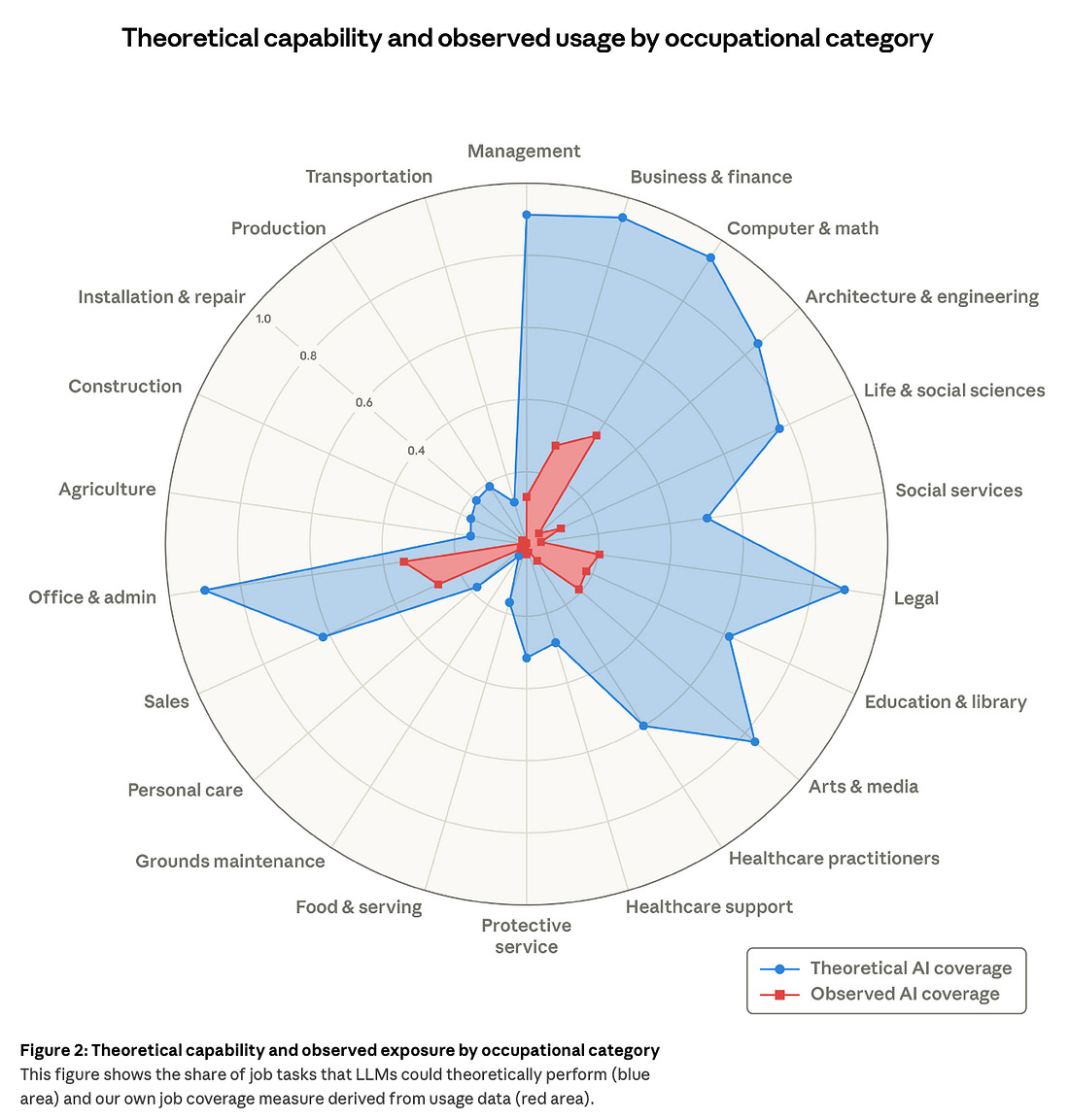
The Big Plug👉 I’ve got a new course! GEO 101 for Marketers. 👉 Just updated! The Unofficial LinkedIn Algorithm Guide, March 2026, now with new information straight from LinkedIn! Content Authenticity Statement100% of this week’s newsletter content was originated by me, the human. Learn why this kind of disclosure is a good idea and might be required for anyone doing business in any capacity with the EU in the near future. Watch This Newsletter On YouTube 📺 Click here for the video 📺 version of this newsletter on YouTube » Click here for an MP3 audio 🎧 only version » What’s On My Mind: How To Measure Whether AI Will Take Your JobIn this week’s newsletter, let’s talk About Anthropic’s recent workplace AI study that many folks, including myself, shared. In it, they showed the theoretical maximum impact of AI on professions and then the current use based on Claude aggregated usage.
I thought the study overall was directionally helpful, to understand broadly what industries are already seeing impact and what the probable highest impact areas are, but these are at the macro level. That’s understandable both from a privacy protection angle as well as having enough data. But that got me thinking - what if we could drill down further, to understand our personal exposure to AI in a more focused way? What if we could see the theoretical maximum impact for our specific careers or even our current jobs? One of the biggest questions everyone has at every event I speak at is w”hen is AI going to take over my job?” People want to know about AI’s impact to them personally. They want to know “how exposed am I or my kids or my friends to AI and employment risks”. How could we go about doing this? Unsurprisingly, we use AI for it. Let’s explore how. Part 1: Identifying TasksAt Trust Insights we spend a heck of a lot of time on frameworks to help contextualize AI. One of ours, the TRIPS framework, looks at five factors to evaluate any task:
The TRIPS framework is often something that we use when we’re auditing companies for AI readiness, but it’s also something that AI itself is quite good at evaluating. Our first step is to understand the most common tasks for any given position. The easiest way to do this is to grab a small collection of job descriptions. Head over to your favorite job board and put in your job title or position - your current one, and if you’re thinking about making a change, an aspirational job title. Copy and paste 3-5 job descriptions for that position so you get a sense of what’s involved in a job, then put that all in a text document. Once you’ve done that, ask your favorite AI of choice to make a granular list of tasks that comprise the job. Here’s a starting prompt.
Copy and paste the TRIPS framework after. What you’ll end up with is a pile of YAML, a data format that AI is excellent at reading. This is likely to be quite extensive, and that’s good. The more granular and specific we can be, the better. Part 2: Identifying Theoretical MaximaNext, we need to ask AI to amend the YAML array with some scoring based on how likely it is any individual task can be automated by AI. We’ll add that as a field into the YAML array. As a sidebar, one of the reasons we want to do this in YAML is that YAML is a single column linear data format that AI is not only good at reading, but can be broken up into chunks if necessary without losing data. Large Language Models (LLMs) have a much easier time breaking up a YAML array into chunks and processing them individually or in small batches than they do, say, a spreadsheet. Why? Because the descriptive data is never lost; in a spreadsheet, the descriptive data is usually the first row, so if you truncate a table after row 100, row 101 doesn’t have the headers and so you have less of an idea about what a row is about in the next batch of data. YAML, JSON, XML, and similar formats all keep the descriptive data with the data itself in every row of data. With that in mind, let’s now add to our tasks file. We need to be specific to help an LLM consider the task and the likelihood a machine can successfully complete that task with today’s frontier models, so here’s a fairly dense starting prompt.
What we end up with is a large YAML array of our tasks that make up our job, the TRIPS scores for how good a candidate task is for AI, and the AI’s judgement based on today’s benchmarks of how likely it is AI can succeed at that task. Part 3: Assessing Our Job RiskA job is a collection of tasks. The more tasks that AI consumes, the more likely it is we will feel AI’s impact in our employment, not because AI can do the entire job, but because AI can eat away at tasks until a person’s job is mostly managing AI. And when you’re managing AI, if you have 50 people who did a job (like a content writer, for example), and AI consumes 80% of the tasks, you now only need 10 people managing AI systems to match or exceed the productivity and quality of the original group of 50 people. That is how AI costs jobs. Not by taking your job entirely, but by reducing the number of people in aggregate that are needed to do a particular job because AI does many of the tasks within that job. Based on the large amount of data we now have in our YAML file, we can now direct AI to help us do the analysis. In the same way that Anthropic did their radar chart (which looks cool, even if it’s not the easiest way to read that data), we can have our AI digest the YAML file and turn it into a visualization. Use this as a starting prompt:
We now have a complete assessment of our exposure to AI, of what AI is likely to do to our current job and possibly our career. So, do we just throw our hands up or open a bottle of Scotch? Not at all. Now we dig in. Part 4: Skating Ahead of the PuckWalter Gretzky, the father of hockey legend Wayne Gretzky, once told his child, “Skate to where the puck is going, not to where it is”. (which, by the way, both father and son say is the advice you give to little kids and is generally not great hockey strategy for adults) In the general spirit of the quote, you have a map of where your current position is exposed to AI. If, overall, your position is substantially exposed, meaning that 50% or more of your tasks are things AI could claim, then you should start thinking about reinventing yourself and your career. There are two generally accepted ways to do this. First, you pursue being an early adopter of AI so that you automate away most of your tasks and you become the AI expert in your company at those tasks. The institutional knowledge you encode in the successful operation of AI is what gives you some defense - essentially becoming one of the people that can’t be laid off as easily because you know how to operate the machines. Second, you pursue angles and aspects that are less exposed to AI. Of the task list, which things are economically important (the I in trips) but aren’t tasks that AI is capable of doing well today? In the short term, those are the things you lean into. Both strategies have flaws, namely that AI capabilities are accelerating at an exponential rate and something AI can’t do well today is something it’s likely to do well at tomorrow. Where you have some degree of safety is the speed of adoption, and that leads us back to Anthropic’s chart. For industries that have a low overall theoretical maximum exposure to AI, the second strategy of leaning into the tasks that aren’t ones AI does well is sensible. For industries that have a high overall theoretical maximum exposure to AI but do not have a current large maximum, such as architecture and engineering, then the first strategy is more sensible. And if you’re in an industry where the theoretical and practical maximums are high? For example, if you’re a software developer? That profession is being devoured by machines. While there are growing pains in the adoption of AI for coding, the reality is that, as Anthropic’s Boris Cherny said recently, coding is largely a solved problem now. Human beings should not be manually typing out code any more. And that means it might be time to exit that industry OR pivot your career so that you’re using the outcomes of software development but not focused on deriving economic value from the process of software development any more. This should sound familiar, as I talked about it not too long ago - the value chain and working your way up it. Commodity > Branded Product/Goods > Service > Experience > Transformation Knowledge work outputs are almost free with AI. Suno can create music. Claude can write books. Codex et. al. can code. Nano Banana can paint, draw, photograph, etc. and as long as someone competent is directing the tools or the tools are harnessed properly to do it themselves, which they can do now, these knowledge products are commodities. “Screw you, Chris, I’m not a commodity and that’s insulting!” You’re not a commodity, but your basic output is IF you don’t work your way up the value chain. Remember Porter’s 5 Forces? If the customer doesn’t have a strong preference and just wants an escapist book, AND they don’t understand your value prop, then an AI-generated trashy romance novel is just as good as a human one. Which means you have to evolve up the value chain. A book is a book UNLESS you’ve built such a strong brand that people want YOU by name, and then your book becomes a movie, a TV series, and ultimately something like a theme park attraction at the highest level of evolution. Musicians understand this well. Music is a commodity by itself UNTIL someone dials into your brand. And the best musicians convert a branded product into a service - like live concerts. Those concerts become epics unto themselves, true experiences (ask any Swiftie), and the best experiences are personally transformative that people pay hilarious amounts of money for. As you look at the tasks that are most exposed to AI, I would bet you most of those are commodity outputs, which means that if you want to be perceived as economically valuable, you have to work your way up the value chain. Your commodity output could be wrapped in a service, turned into an experience, or even a transformation - and that’s how you’ll stay ahead of AI (or more likely, use AI to achieve those leaps). How? With a prompt like this. Pick any one task that scores an 8 or above from the YAML file. Start with this prompt, then paste the task below it along with the Trust Insights TRIPS framework. Also consider including your CV.
What you should get is a nice set of recommendations for ways to uplevel that task to keep it as human as possible for as long as possible. We ultimately want to know what people will still give us a paycheck for. Part 5: Wrapping UpThis issue wasn’t meant to scare you, but it absolutely is meant to be a wake up call for all of us, in every job and career, to recognize where we are exposed to AI taking away tasks. The sooner we have a clear-eyed view of that, the sooner we can act to shore up our value to our companies and customers by either being in charge of AI or finding the niches and opportunities outside of AI. The exercises in part four of taking tasks that are vulnerable to AI and up-leveling them to things that people would still want to pay you for is where your next steps are. If you do that exercise for your own background and your job description and the things that you do the most of, you will find ways to remain valuable even as AI technology improves, because you can go back through this entire process from the very beginning as AI technology changes, change the prompts, change the background data, and keep generating new recommendations for how you can continue to add value. I guess in some ways, this is the third path of not just being in charge of AI or not just finding niches where AI doesn’t operate well, but finding those unique opportunities that take your background into account and your capabilities and ultimately help you deliver AI-enabled versions of your work that people still are willing to pay you money for. So I hope this was helpful. I hope this was useful. Please try it out. How Was This Issue?Rate this week’s newsletter issue with a single click/tap. Your feedback over time helps me figure out what content to create for you. Here’s The UnsubscribeIt took me a while to find a convenient way to link it up, but here’s how to get to the unsubscribe. If you don’t see anything, here’s the text link to copy and paste: https://almosttimely.substack.com/action/disable_email Share With a Friend or ColleaguePlease share this newsletter with two other people. Send this URL to your friends/colleagues: https://www.christopherspenn.com/newsletter For enrolled subscribers on Substack, there are referral rewards if you refer 100, 200, or 300 other readers. Visit the Leaderboard here. ICYMI: In Case You Missed ItHere’s content from the last week in case things fell through the cracks:
On The TubesHere’s what debuted on my YouTube channel this week: Skill Up With ClassesThese are just a few of the classes I have available over at the Trust Insights website that you can take. PremiumFree
Advertisement: New GEO 101 CourseWhen I talk to folks like you, being recommended by AI is one of your top marketing concerns in 2026. We’ve taken everything we’ve learned from OpenAI’s documentation, Google’s technical papers, patents, sample code, plus our years of experience in generative AI to assemble a high-impact 90-minute course on GEO 101 for Marketers. In this course, you’ll learn:
This course is meant to be used. In addition to the course itself, you’ll also receive:
And best of all, this is our most affordable course yet. GEO 101 for Marketers is USD 99 and is available today. 👉 Enroll here in GEO 101 for Marketers! Get Back To Work!Folks who post jobs in the free Analytics for Marketers Slack community may have those jobs shared here, too. If you’re looking for work, check out these recent open positions, and check out the Slack group for the comprehensive list. Advertisement: My AI Book!In Almost Timeless, generative AI expert Christopher Penn provides the definitive playbook. Drawing on 18 months of in-the-trenches work and insights from thousands of real-world questions, Penn distills the noise into 48 foundational principles—durable mental models that give you a more permanent, strategic understanding of this transformative technology. In this book, you will learn to:
Stop feeling overwhelmed. Start leading with confidence. By the time you finish Almost Timeless, you won’t just know what to do; you will understand why you are doing it. And in an age of constant change, that understanding is the only real competitive advantage. 👉 Order your copy of Almost Timeless: 48 Foundation Principles of Generative AI today! How to Stay in TouchLet’s make sure we’re connected in the places it suits you best. Here’s where you can find different content:
Listen to my theme song as a new single: Advertisement: Ukraine 🇺🇦 Humanitarian FundThe war to free Ukraine continues. If you’d like to support humanitarian efforts in Ukraine, the Ukrainian government has set up a special portal, United24, to help make contributing easy. The effort to free Ukraine from Russia’s illegal invasion needs your ongoing support. 👉 Donate today to the Ukraine Humanitarian Relief Fund » Events I’ll Be AtHere are the public events where I’m speaking and attending. Say hi if you’re at an event also:
There are also private events that aren’t open to the public. If you’re an event organizer, let me help your event shine. Visit my speaking page for more details. Can’t be at an event? Stop by my private Slack group instead, Analytics for Marketers. Required DisclosuresEvents with links have purchased sponsorships in this newsletter and as a result, I receive direct financial compensation for promoting them. Advertisements in this newsletter have paid to be promoted, and as a result, I receive direct financial compensation for promoting them. My company, Trust Insights, maintains business partnerships with companies including, but not limited to, IBM, Cisco Systems, Amazon, Talkwalker, MarketingProfs, MarketMuse, Agorapulse, Hubspot, Informa, Demandbase, The Marketing AI Institute, and others. While links shared from partners are not explicit endorsements, nor do they directly financially benefit Trust Insights, a commercial relationship exists for which Trust Insights may receive indirect financial benefit, and thus I may receive indirect financial benefit from them as well. Thank YouThanks for subscribing and reading this far. I appreciate it. As always, thank you for your support, your attention, and your kindness. Please share this newsletter with two other people. See you next week, Christopher S. Penn Invite your friends and earn rewardsIf you enjoy Almost Timely Newsletter, share it with your friends and earn rewards when they subscribe.
|






Comments