Almost Timely News: 🗞️ A Sober Conversation about AI and Employment (2026-04-26)

Almost Timely News: 🗞️ A Sober Conversation about AI and Employment (2026-04-26)What is worth paying a human for?
Almost Timely News: 🗞️ A Sober Conversation about AI and Employment (2026-04-26) :: View in Browser
The Big PlugsSo many new things! 3️⃣ A free 25 minute webinar Katie and I did on GEO - even though it says the date is past, it still works and takes you to the recording. Content Authenticity Statement100% of this week’s newsletter content was originated by me, the human. You’ll see me working with Gemini and Claude in the video version. Learn why this kind of disclosure is a good idea and might be required for anyone doing business in any capacity with the EU in the near future. Watch This Newsletter On YouTube 📺
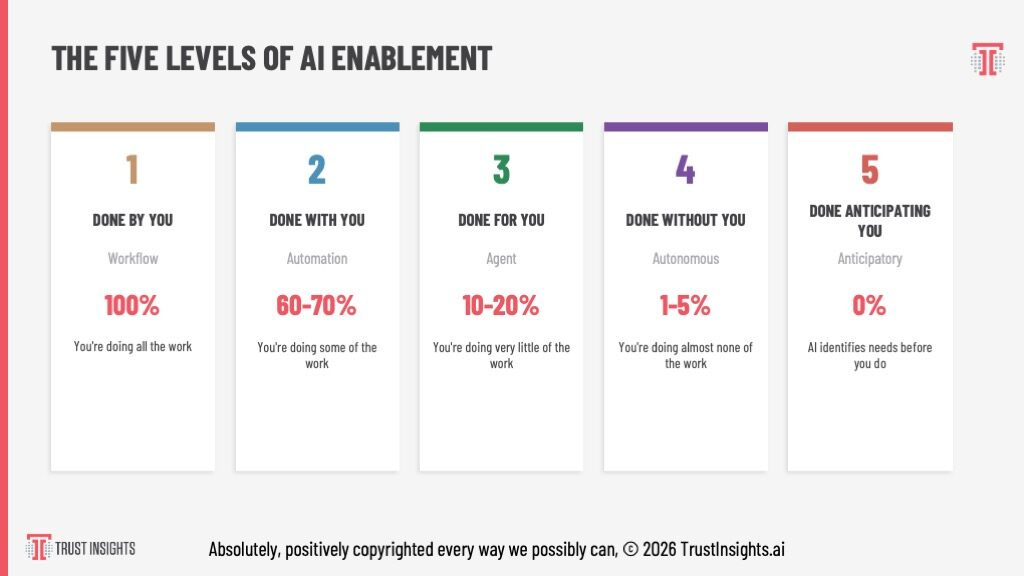
Click here for the video 📺 version of this newsletter on YouTube » Click here for an MP3 audio 🎧 only version » What’s On My Mind: A Sober Conversation about AI and EmploymentThis week, let’s have a sober conversation about AI’s impact on employment. This is a topic that I’ve talked about in the past, but after the events of this week, it’s worth revisiting. Part 1: What Happened This WeekThis isn’t big industry news or politics or a reaction to so-and-so being on so-and-so’s podcast. This is a reaction to me deploying Hermes Agent. For a few months now, we’ve all been playing with various agentic systems and hearing about many more - OpenClaw, NemoClaw, etc. But Hermes Agent, from the Nous Hermes research team, is the first one that I’ve really gotten to do some pretty incredible things. As a reminder, agents like these live at Level 4 in the Five Levels of AI Enablement. They’re mostly fire-and-forget - you set up a great project plan with a clear measure of success, and then it just goes off and does its thing. You’re not an active participant after launch.
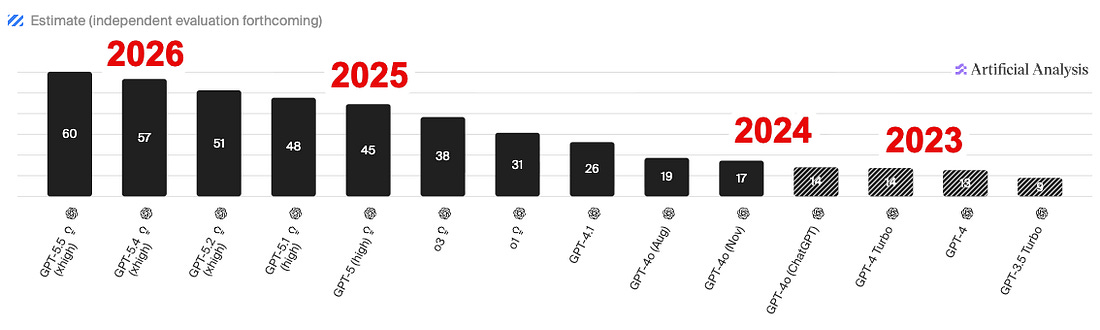
During one of the morning walks with my partner and dog, I was lamenting the sorry state of my town’s local paper. It’s a compilation of slop - recycled news stories from regional or national publications and ChatGPT-fueled local news because the paper is down to, like, an editor and an intern and that’s it. It’s unhelpful, and like too many journalistic outfits that need to pay the bills, filled with sensationalist crap needed to attract clicks. So I said to myself, this is the perfect test for a truly agentic AI system, a system that can generate my own newspaper, in the style I want it, with the news I want. What news do I want? I want to know what’s going on in the local community. The town police have a daily police log. The library has a calendar of events. City Hall keeps a calendar and a newsroom. Local venues have their own calendars and press rooms. So I sat down and used the 5P Framework by Trust Insights™ to craft a 13-page project plan for the agent to implement. I handed it off, and two and a half hours later, the first issue of my paper dropped into my Discord server as a PDF. And it met the requirements I set out for it. It’s a local paper. There are some quirks and bugs that I’d need to tune up if I wanted to make this available to other people but for the most part, it’s ready to go. An AI agent made me a local newsroom, filled with all the stories you would expect of an actual local paper. Earth Day celebrations and food trucks at the town common this weekend. A cornhole tournament at the local park next weekend. A couple of local breaking and entering reports plus some public drinking arrests in the police log. What’s notable about this paper is that there’s no editorial judgement of what’s newsworthy in the sense that it’s going to attract clicks or sell ad space. None of those are concerns because there’s a subscriber base of one and no employees at all, so commercial considerations about what will sell are irrelevant. There are no advertisers to please. And if I wanted to? I could have the agent bundle up all the skills it made, all the code it wrote, and publish that code so that someone else could add it to their agent and get my take on a local paper. Think how many people used to work at local papers in the days before the Internet (because the Internet itself is what killed local papers, especially early services like Craigslist that wiped out classified ads revenue). At a minimum, you’d need a reporter, ideally an editor, a salesperson for advertising revenue, and someone who knows how to do gaphic design and layouts. At my state’s minimum wage levels, that’s USD 160,000 per year gross at state minimum wage, 40 hours a week, to run a local newspaper. Or an AI agent, a dedicated computer that cost USD 300 (one time purchase, and it runs multiple agents), and a monthly coding subscription (I use Minimax for this) that’s USD 17 a month. And if I can produce a paper for one person, I could obviously produce it for other people at no additional costs because it’s a digital good. One person or a million, it’s more or less the same cost to produce. Which brings me to part 2, about where the tech is. Part 2: Where AI Is and Where It’s GoingWe can’t have a meaningful discussion about the effect of AI on employment and jobs without first understanding where AI itself is. Many people are mentally stuck in 2024 - the golden age of basic ChatGPT usage. Sit down at your browser, start chatting, get responses, copy and paste, etc. And from late 2022 through most of 2024, that was the dominant use case. And that was the best use case because the technology was still evolving. It took two full years before web search was a standard part of generative AI tools. It’s only really been in the last 16 months that we’ve seen generative AI models explode in capabilities. At the start of 2025, they were still more or less face-rolling idiots at a lot of tasks. By the end of 2025, they were PhDs in most tasks. This chart from Artificial Analysis shows the blended intelligence index for OpenAI’s models from the very first commercial model, GPT-3.5-Turbo that powered the OG ChatGPT to this week’s GPT-5.5.
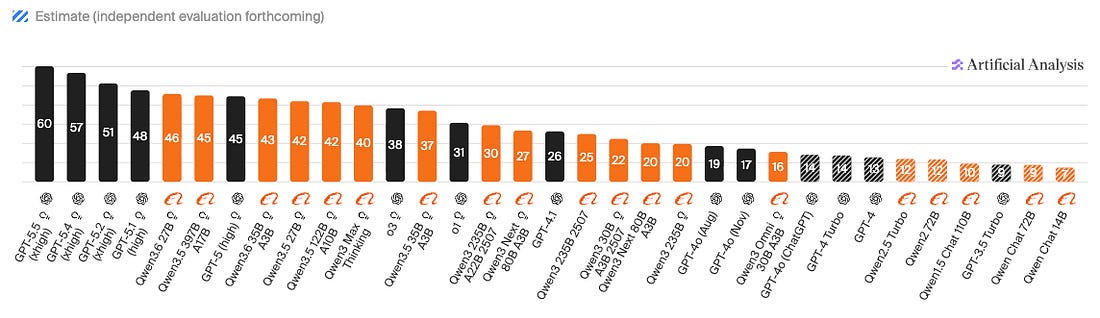
For reference, a human PhD in their field scores an average of about 50 on this index. Here’s where things get shocking. Using Alibaba’s Qwen model as our benchmark for open weights models - that is, models you can download and run on your own hardware and not need a third-party cloud provider if you have enough hardware - this is what the evolution of open weights models looks like over the same period of time:
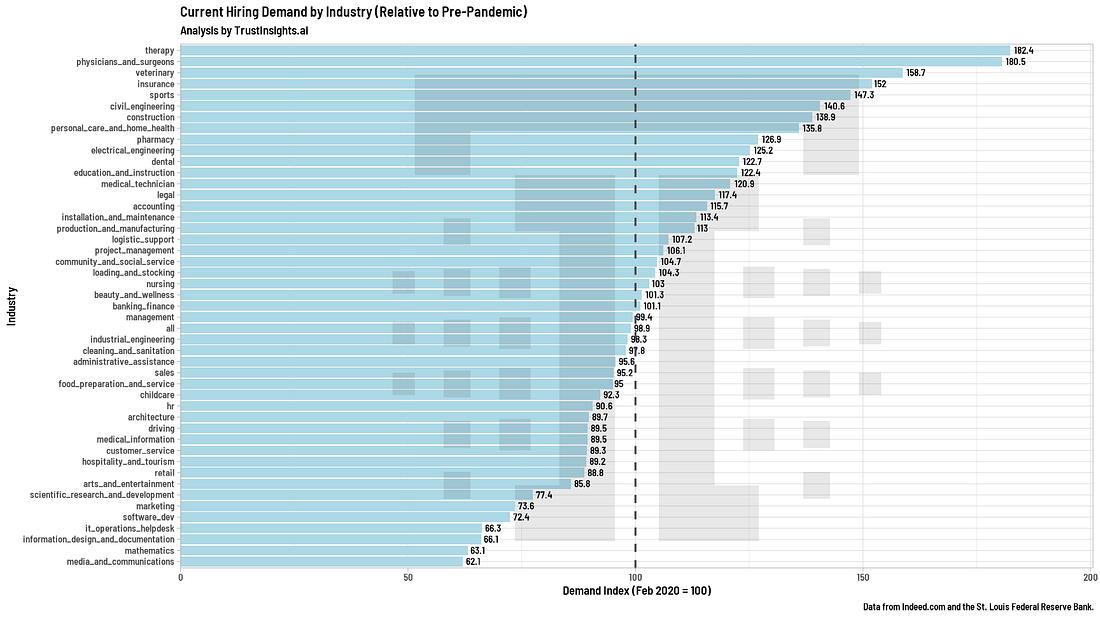
You’ll note that Qwen 3.6 27B, which is their latest model that came out this week, matches the overall intelligence performance of last summer’s GPT-5 and last fall’s GPT-5.1. That is mind-bending to think about, because this is a model that can run on a well-appointed laptop. No data center needed, no nuclear power plant, no river of fresh water to consume - just a well-appointed MacBook. That is how far and how fast these models have evolved from face rolling idiot to PhD, including small models that can run on a laptop with no other support. That’s the models, the engines of generative AI. We can’t talk about AI without also talking about the harnesses, the infrastructure around a model that allows us to use it. In spring of 2025, Anthropic released its first coding environment called Claude Code. It was a shocking piece of software because it was the first mainstream commercial package that autonomously executed on many tasks, requiring much less supervision and much less back and forth chat than any other tool prior to that point. Even in its early days, its capabilities to do long horizon tasks were incredible. I was in a hotel in Washington, D.C., with a friend for a conference and my friend lamented that she had always wanted to write a book, but never had time to do it. And I pointed out that she wrote like three LinkedIn posts a day. So we gathered up with a very early version of Claude Code, all of her LinkedIn posts for the last two years, and over 92 minutes watched it construct a coherent book out of her LinkedIn posts. And when it was done, in 92 minutes, it was a 65,000-word book that used her words, so not AI slop, but her literal words. That was the first time that I watched agentic AI accomplish something really significant and went, “Oh, this is gonna be a thing”. In early 2026, Peter Steinberger invented a far more autonomous system known as OpenClaw, a small virtual machine that had an AI agent that ran autonomously and could execute tasks with minimal prompting. OpenClaw didn’t initially support more than Anthropic models, but the open source community forked it so many times that it became its own ecosystem of agents that could run any size model. What I did in part one with my local newspaper was inspired by the OpenClaw architecture. The Nous Hermes lab built Hermes agent, which is conceptually the same thing. It’s an agentic framework that can accomplish very long horizon tasks with minimal feedback after the initial project plan. Put those two facts together: an agentic framework that is extremely intelligent and highly capable of writing its own software and tuning itself over time, combined with AI models that are smart enough to be PhD level at many tasks, but run on a laptop. That is a recipe for work substitution, because you can have a machine behave like a team of people to accomplish long horizon tasks. That’s where the technology is today. Let’s talk about where the technology is going. While the Western world is focused on building out data centers at an alarming pace, the AI field itself is focused on better code, better research, and better math. It has always been true that whoever has the best math will have the best AI. In March 2026 Google released a paper called TurboQuant. This paper addressed some of the biggest memory and compute bottlenecks in AI, things that make it expensive to run and incredibly energy-intensive. TurboQuant changed how we do a specific computation (key value cache compression). And what the technique shows is that it can achieve 6-8X increases in performance while decreasing the amount of energy needed to run AI. Think about the implications of a technological change like that. Google effectively made every AI data center around the world potentially able to work six to eight times more without a single extra watt of power or a drop of water. And this is just the tip of the iceberg when it comes to better math. There are AI models dedicated to building better math. More important, today’s AI models are actively building themselves. GPT-5.2 famously was derived from GPT-5.1 by itself. Now, OpenAI did not specify what percentage of the model was generated by itself, but it was a non-zero amount. Mini-Max M2.7? 30 to 40% of it was written by itself as it evolved out of Minimax M2.5. This is what is causing the technology to accelerate so fast. The technology, the AI models can write themselves now, and so they can be far more productive than we humans were when we were the ones directing the models’ construction. The technology exists today for companies and individuals to build Level 5 systems. Though there’s none in production, the underlying components are already there, from Milla Jovovich’s MemPalace to Graphify to Serena MCP and so many others. Expect Level 5 systems to be in production by the end of this calendar year. And if you remember, level 5 systems are essentially departments or teams of people. That’s where the technology is and where it’s going. It can substitute for entire teams of people now. Part 3: Effects on EmploymentWhen the only game in town was ChatGPT and there was still a human being copy-pasting everything in and out of the AI, the effects on unemployment were going to be minimal. You’d get efficiencies by having fewer people doing the same job, but in general, you wouldn’t see massive transformation because human beings had to be deeply involved in operating AI. The more we move up levels in the five levels of AI the more the machine takes on, the less we have to do, the less we have to be sitting at the keyboard micromanaging it. At level two, we’re still basically copy-paste monkeys. Yes, Gems and GPTs and projects make it easier to get organized, make it easier to keep processes standardized, but we are still copy-pasting. Once you get to level 3, that’s when the game changes, when you go from being an individual contributor to becoming a manager, and what you are managing is a machine. When we look at Indeed.com’s hiring demand by industry snapshot as of last week, and the industries where demand is below pre-pandemic levels? The bottom five are software development, IT operations and help desk, information design and documentation, mathematics, and media and communications. By the way, marketing is sixth from the bottom.
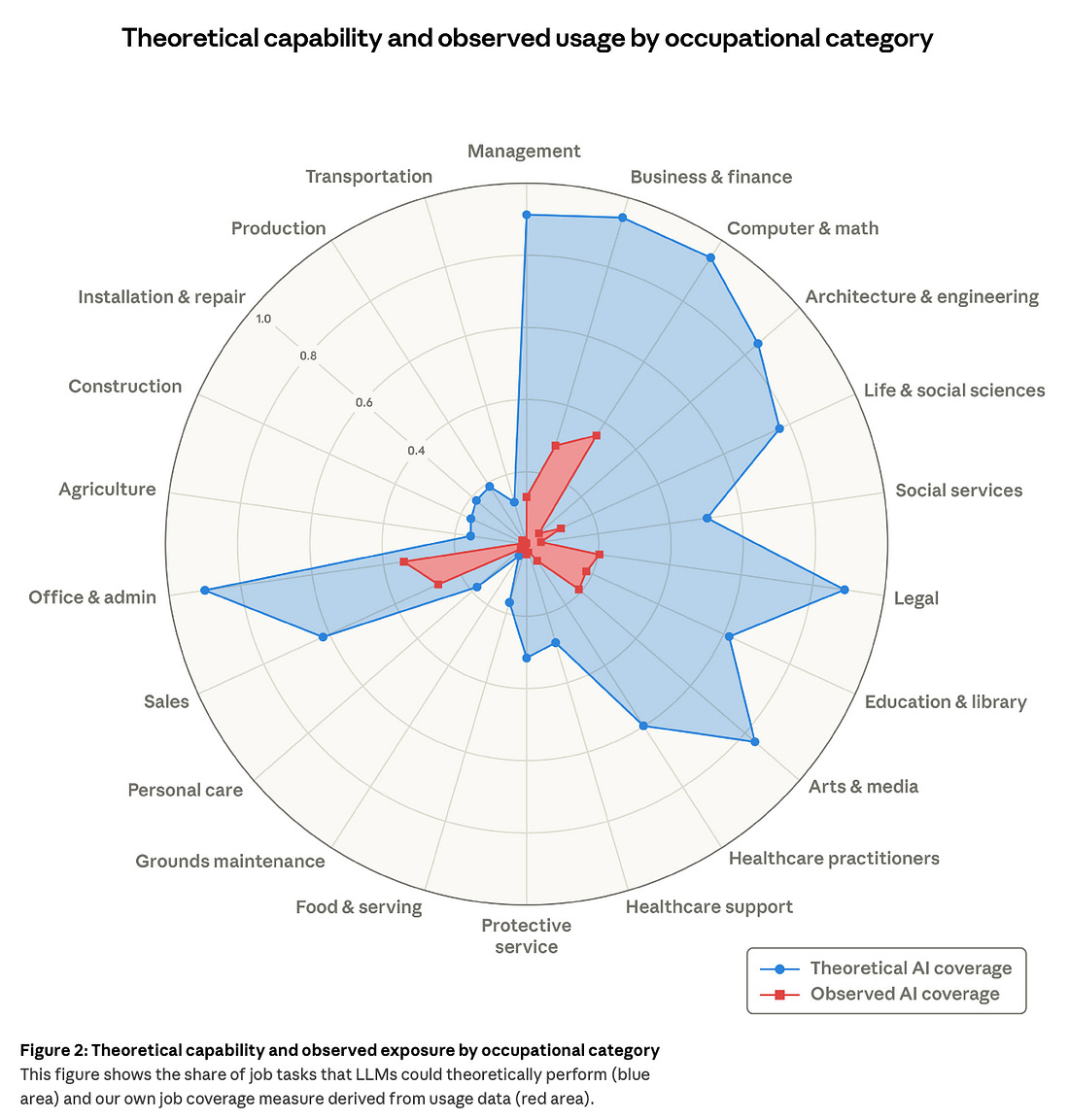
When Trust Insights first started tracking this chart, the numbers for those fields were 100. Today they’re in the 60s and 70s, which means that hiring demand has fallen by 30% or more from February 2020. Now, to be clear, there are other things besides AI having impacts on markets and hiring demand. There’s been two major regional wars since 2022, starting with the illegal invasion of Ukraine by Russia, there’s been a pandemic, and the long-term consequences of that pandemic are still playing out, there are massive political changes around the world. So, AI alone is not the sole contributor of this change in hiring demand, but it is part of the equation. But we haven’t seen AI’s biggest effects yet. As I pointed out in the March 15 newsletter, Anthropic’s own chart of the theoretical maximum effect of AI on professions is largely unfulfilled:
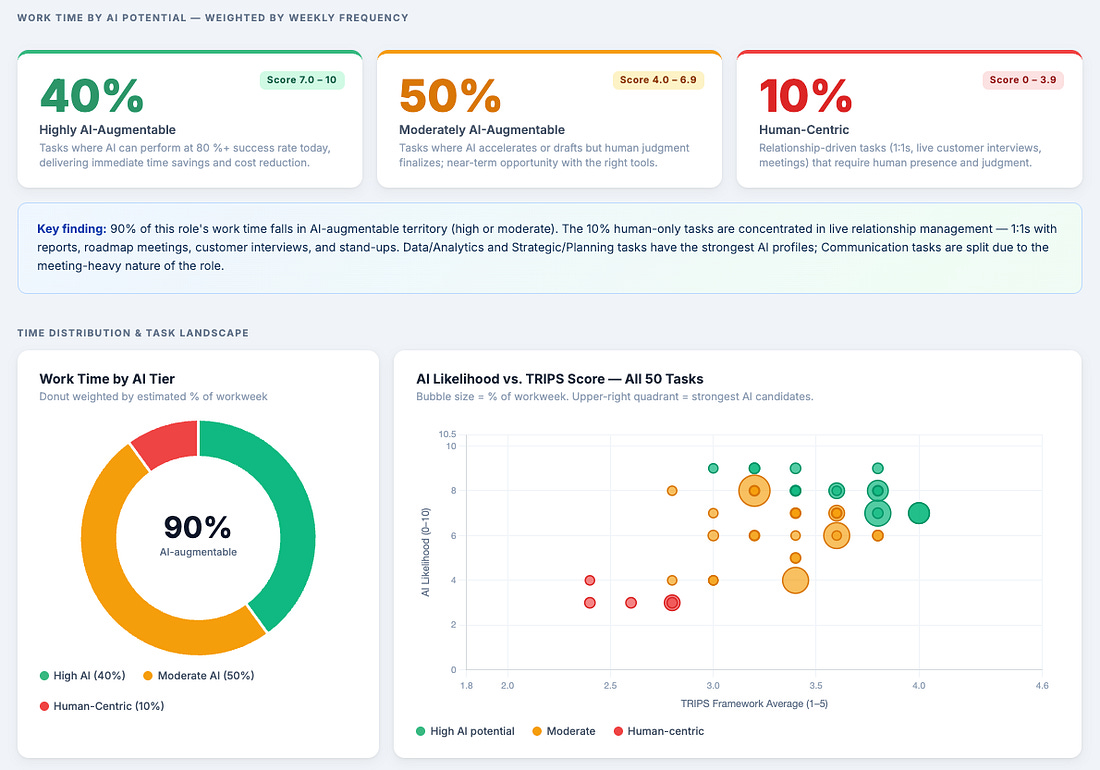
The red sections of the chart show the impact on those markets, where the blue is the likely impact of AI on those markets. Even still, in things like software, we see that software coverage is now up to almost 40%. Office and admin is up to almost 40%. I spoke to a recruiter recently in the temp jobs industry placing office temps and they said business has dropped precipitously; in one month they went from placing ~80 temps to ~15, an 80% decrease in demand. There is no industry on the planet that can tolerate an 80% decrease in demand and still remain healthy. Look more carefully at the Anthropic chart. Almost 40% of office jobs are currently seeing AI impact. Almost 30% of sales jobs. Almost 20% of legal jobs. 20% of education jobs, 20% of arts and media jobs, 30% of business and finance jobs, 40% of computer jobs. These are huge numbers for a technology that is still only about four years old. Even if AI were to freeze where it is today, these are still massive changes to these industries. Even a five or ten percent decrease in employment in an industry has massive, far-reaching effects. Take any given job description and hand it to AI. Use the agentic tool of your choice to digest it down and see how many of the tangible tasks are exposed to AI. Here’s an example of a director of product marketing job I saw on LinkedIn earlier, using the Trust Insights TRIPS framework
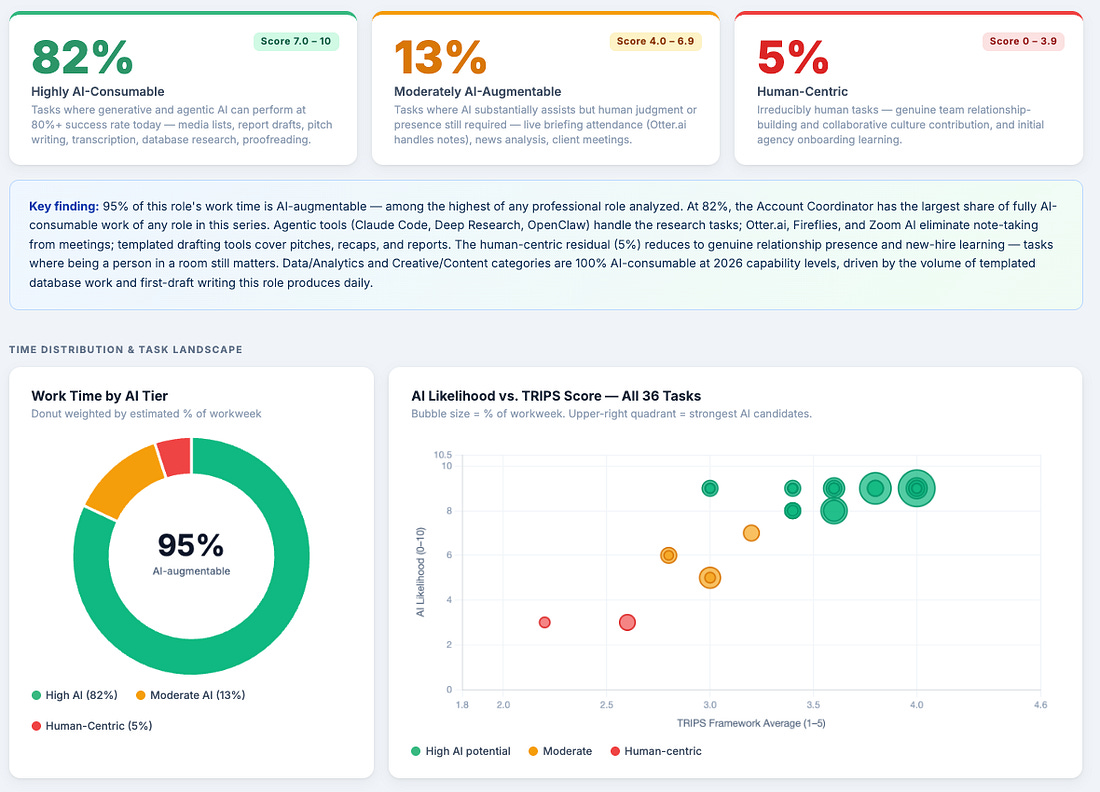
With today’s agentic capabilities, 40% of this position can be readily handed off to AI. Another 50% can be AI accelerated, and 10% is purely human, which machines would do poorly at. Combined, 90% of this role could be accelerated in some way by AI, meaning that if you had more than one open position in this role, you could pretty easily consolidate two people down to one - and this is a fairly senior position. Impact on junior positions is way more dramatic. This is an account coordinator position at a public relations firm. And we’re going to put it through the same process in Claude as the senior position. And let’s just see what the difference is between a junior position and a senior position in terms of its exposure to AI:
When we look at the account coordinator position, 82% of this role can be consumed by AI. 13% moderately augmentable, 5% human-centric. The impact of AI on junior position employees can’t be overstated. A company does not need this role to be filled by a human. It would be fiscally irresponsible to pay someone - this role pays $51,000 a year - it would be fiscally irresponsible to pay a human to sit in this seat and do these tasks. If we dig deeper, some of the conversation in places like Threads talks about managers and executives who now consult generative AI for a second opinion on everything - or in a shocking number of cases, a first opinion. As people cognitively de-skill at many core tasks, they hand them off to machines. If enough of your thinking goes to a machine, at a certain point an employer rationally has to realize they don’t need you at all - from the mail room to the corner office. This is the single greatest red flag for any individual worker. If you find that you are handing off more and more tasks to AI, you are being productive, to be sure, but you are also building a case that an employer no longer needs you. While it’s difficult to arbitrarily declare that a specific percentage or number of tasks is a red line, it’s probably a fairly safe bet to say that if more than 50% of your tasks are being done solely by a machine and there’s more than one person in your role at your company, you are endangering your employment. If more than 80% of your tasks are now being done by machines, you are definitely endangering your employment. Part 4: EthicsUp until now, we’ve talked mostly about individual risks and rewards of AI. No discussion of AI’s effects on employment would be complete if we didn’t talk about the ethics and the systemic nature of AI. I’ve been doing a lot of speaking at private company meetings and gatherings in the last couple of months, things that don’t belong on the events calendar. At these meetings, the one thing I’m hearing more and more is that there are top down management dictates that AI use increase dramatically. More often than not, there isn’t a clear rationale for it other than “productivity”, and they all sound the same, like every C-Suite is reading the same articles while on the plane. Productivity is a polite word for getting more out of people at the same or lower rates of pay. We even have an entire management culture around this, “do more with less”, the eternal trope of top management. But there are consequences for this style of management that AI makes far worse. In its current form, AI dramatically accelerates income inequality. There is no way to sugarcoat that. When you substitute human wages for machine fees, that money goes to fewer people. When we pay Claude or ChatGPT or Gemini our USD 20 a month or USD 200 a month or whatever fee is for your country, that money goes to a technology company that, in the big picture, supports relatively few people. Workers at companies get fewer wages and the company keeps those wages as additional profits for shareholders. As much as I love Claude or Gemini, paying them instead of humans means two things. First, the relatively small number of people employed by these companies enjoy the benefits of those fees and spend them in their communities. Those wages that are paid to maintain and improve the software are highly concentrated. When you pay a human being to do a task in your community, they spend that money in your community. They go to the grocery store, they go to the bowling alley, they go to the local restaurants - money paid as wages to local labor supports your local ecosystem. Unless you live in a major tech hub, you don’t see the benefits of the fees you pay to a tech provider for AI systems and software. The second and arguably greater impact of generative AI is that it depresses wages for everyone. If a task takes a human worker USD 100 of wages to complete but it takes a machine one dollar of wages to complete, then in the free market, that task and its output is now worth one dollar. That is what the market has decided is the value of that task, and that is what the market will pay for that work. Again, rationally, if I can buy the same output for one dollar, why would I pay one hundred dollars for the same thing? That’s what the newspaper example shows in stunning clarity. A product, such as a local newspaper, would cost USD 160,000 in wages at minimum wage for four employees, about USD 13,333 per month. The same product made by a machine costs me USD 20 per month, rounding up. That’s a 99.8% decrease in value, in what it costs to make that good. That is part of the reason why local newspapers have all but vanished, because the substitution of other information products is cheaper, and users of the older product don’t see a reason to keep paying for it. Thanks to questionable judgment around monetary policy in many nations, according to the OECD, inflation is already on the rise, meaning that there is more money chasing fewer goods. The net effect of inflation, which is when the government prints more money than there are goods to match, is that prices go up. Combine that with wage depression and you have a toxic cocktail of economic collapse for the majority of knowledge workers. Tasks that might have been outsourced to developing nations are now being onshored to machines. Tasks that you might have increased headcount for in the past are now being done by the same number of people and more machines. What this means is that AI in its current incarnation with the current companies running it is dramatically increasing income inequality and making most people poorer by devaluing the work that they produce. Part 5: Difficult AnswersIn the short term, the capabilities that AI offers us allow us for entrepreneurship at unparalleled speeds. The distance to done, the distance between having an idea and turning into something that is tangible, is shorter than ever and grows shorter every day as AI agents gain ever-increasing capabilities. If you’ve got a good idea, you can bring it to life faster than ever. In turn, that means you could beat the overall trend of knowledge products decreasing in value if you can come up with something novel and bring it to market quickly or sell it quickly. That’s where the opportunity is right now. We should expect that continued downward pressure will occur for wages paid for tasks that machines can now consume. Entrepreneurship, multiple income streams, innovation and cross-disciplinary skills will be some of the lifeboats you’ll need. Having a strong professional community network will arguably be the single biggest advantage you can have. If you are not investing time in your professional community and your professional community every single day, you are imperiling your future because in today’s employment landscape, AI has created massive distortions. On one hand, you have job seekers who are using AI to all sound alike. Everybody’s an expert who applies for a job. And on the other hand, you have recruiters and HR professionals using AI to deal with the deluge of candidates who... a lot of them very unqualified. The only way to stand out is for someone else to refer you in a warm referral to the hiring manager, and that relies on having a strong professional community. But these aren’t the big picture. Just as there is no way to sugarcoat the truth about AI’s impact on economies and wages, nor is there a way to sugarcoat the consequences of dramatic income inequality. We only need to look through the history books to know how this will play out if nothing changes. In the past, when structural unemployment, meaning jobs were lost that were never coming back, spiked 5 to 10 percent within a 10-year period, civil unrest typically followed. In many places, this resulted in very bloody revolutions - France in 1789, England in 1811, a good chunk of Europe in 1848, the Russian revolution of 1917, Mussolini’s rise in 1919, the Weimar Republic in 1929 that led to World War 2, the fall of the Shah in 1978, Tunisia and Egypt in 2011.
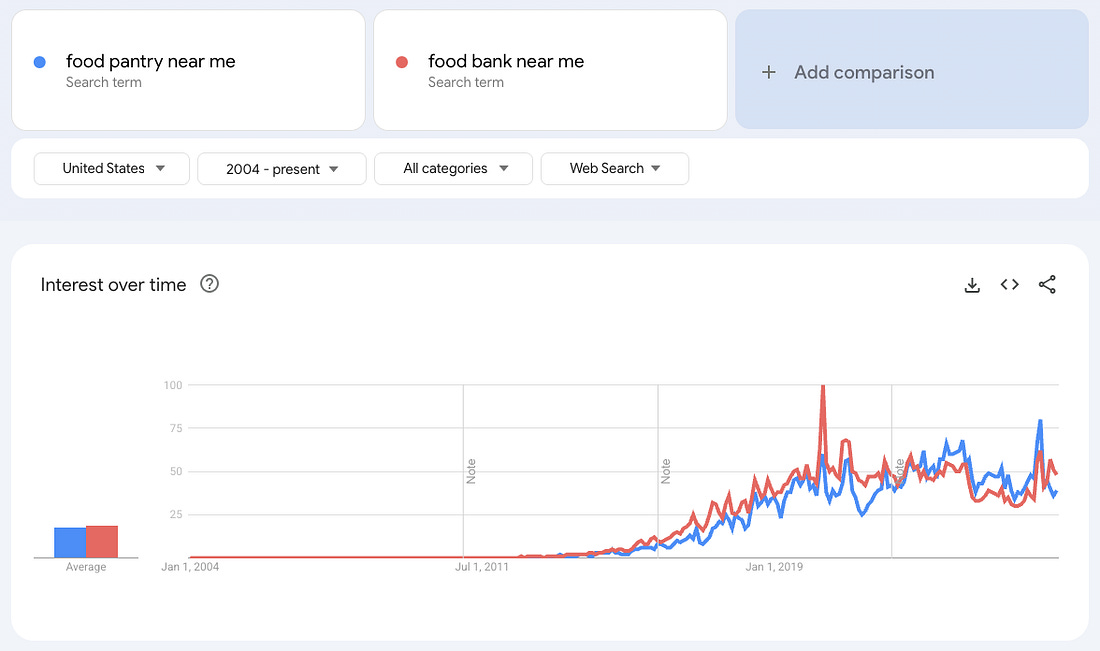
If we pay attention to data coming from real people and not from potentially corrupted government sources, such as Google searches for specific terms like food pantry near me, we see enormous economic pressures on people. Google Trends data goes back to 2004, and what we see is that beginning in 2016 through today in the USA, demand for food pantries and food banks has been ever increasing. Perform similar research in the place where you live, if the USA is not your home country, and see how things are changing near you. This is the canary in the coal mine. When even the basics of life are not being met by people, at a certain point, people snap and reboot their society. And as I said, it’s not usually bloodless. Many solutions such as robot taxes have been proposed, and those solutions are not bad on the surface until we consider the economics of them. Point 2 from part 4 on wage substitution means that even if we were to charge a 50% tax on the use of AI for any given job, if we are looking at a 99.8% decrease in wages paid from human to machine, that tax will not bring in nearly enough money to cover the lost wages. The money you pay a machine to do a task that formerly was done by a human will be so much less that even seizing 100% of it for social programs will be ineffective. Other solutions like universal basic income are more realistic to a degree in that if we can provide basic necessities for people, such as food, clothing, and shelter, we can provide at least a minimum standard of living. Advanced economies such as in Scandinavian nations are trying this out with good success in pilot programs. What we have to do globally is figure out how to fund that as quickly as possible, because the window of opportunity to make societal changes before we get to guillotines and pitchforks and torches is very small. Ultimately, however, we have to figure out how human beings can generate work worth paying them for. At the end of the day, that is the biggest question we have to answer: what is worth paying a human for? I don’t have those answers right now. I’m not sure any AI has those answers. But we collectively need to be able to answer that question - and soon. How Was This Issue?Rate this week’s newsletter issue with a single click/tap. Your feedback over time helps me figure out what content to create for you. Here’s The UnsubscribeIt took me a while to find a convenient way to link it up, but here’s how to get to the unsubscribe. If you don’t see anything, here’s the text link to copy and paste: https://almosttimely.substack.com/action/disable_email Share With a Friend or ColleaguePlease share this newsletter with two other people. Send this URL to your friends/colleagues: https://www.christopherspenn.com/newsletter For enrolled subscribers on Substack, there are referral rewards if you refer 100, 200, or 300 other readers. Visit the Leaderboard here. ICYMI: In Case You Missed ItHere’s content from the last week in case things fell through the cracks:
On The TubesHere’s what debuted on my YouTube channel this week: Skill Up With ClassesThese are just a few of the classes I have available over at the Trust Insights website that you can take. PremiumFree
Advertisement: New GEO 101 CourseWhen I talk to folks like you, being recommended by AI is one of your top marketing concerns in 2026. We’ve taken everything we’ve learned from OpenAI’s documentation, Google’s technical papers, patents, sample code, plus our years of experience in generative AI to assemble a high-impact 90-minute course on GEO 101 for Marketers. In this course, you’ll learn:
This course is meant to be used. In addition to the course itself, you’ll also receive:
And best of all, this is our most affordable course yet. GEO 101 for Marketers is USD 99 and is available today. 👉 Enroll here in GEO 101 for Marketers! Get Back To Work!Folks who post jobs in the free Analytics for Marketers Slack community may have those jobs shared here, too. If you’re looking for work, check out these recent open positions, and check out the Slack group for the comprehensive list.
Advertisement: My AI Book!In Almost Timeless, generative AI expert Christopher Penn provides the definitive playbook. Drawing on 18 months of in-the-trenches work and insights from thousands of real-world questions, Penn distills the noise into 48 foundational principles-durable mental models that give you a more permanent, strategic understanding of this transformative technology. In this book, you will learn to:
Stop feeling overwhelmed. Start leading with confidence. By the time you finish Almost Timeless, you won’t just know what to do; you will understand why you are doing it. And in an age of constant change, that understanding is the only real competitive advantage. 👉 Order your copy of Almost Timeless: 48 Foundation Principles of Generative AI today! How to Stay in TouchLet’s make sure we’re connected in the places it suits you best. Here’s where you can find different content:
Listen to my theme song as a new single: Advertisement: Ukraine 🇺🇦 Humanitarian FundThe war to free Ukraine continues. If you’d like to support humanitarian efforts in Ukraine, the Ukrainian government has set up a special portal, United24, to help make contributing easy. The effort to free Ukraine from Russia’s illegal invasion needs your ongoing support. 👉 Donate today to the Ukraine Humanitarian Relief Fund » Events I’ll Be AtHere are the public events where I’m speaking and attending. Say hi if you’re at an event also:
There are also private events that aren’t open to the public. If you’re an event organizer, let me help your event shine. Visit my speaking page for more details. Can’t be at an event? Stop by my private Slack group instead, Analytics for Marketers. Required DisclosuresEvents with links have purchased sponsorships in this newsletter and as a result, I receive direct financial compensation for promoting them. Advertisements in this newsletter have paid to be promoted, and as a result, I receive direct financial compensation for promoting them. My company, Trust Insights, maintains business partnerships with companies including, but not limited to, IBM, Cisco Systems, Amazon, Talkwalker, MarketingProfs, MarketMuse, Agorapulse, Hubspot, Informa, Demandbase, The Marketing AI Institute, and others. While links shared from partners are not explicit endorsements, nor do they directly financially benefit Trust Insights, a commercial relationship exists for which Trust Insights may receive indirect financial benefit, and thus I may receive indirect financial benefit from them as well. Thank YouThanks for subscribing and reading this far. I appreciate it. As always, thank you for your support, your attention, and your kindness. Please share this newsletter with two other people. See you next week, Christopher S. Penn Invite your friends and earn rewards
If you enjoy Almost Timely Newsletter, share it with your friends and earn rewards when they subscribe.
|






Comments