Almost Timely News: 🗞️ A Better Mental Model of AI for GEO (2026-05-31)

Almost Timely News: 🗞️ A Better Mental Model of AI for GEO (2026-05-31) :: View in Browser
The Big Plug👉 This Friday, come check out a free Trust Insights webinar on competitive GEO. Full disclosure, it is also a gentle sales pitch for our GEO 201 course, also coming this Friday. Content Authenticity Statement100% of this week’s newsletter content was originated by me, the human and reorganized by Claude Opus 4.8 from my voice recordings. Learn why this kind of disclosure is a good idea and might be required for anyone doing business in any capacity with the EU in the near future. Watch This Newsletter On YouTube 📺
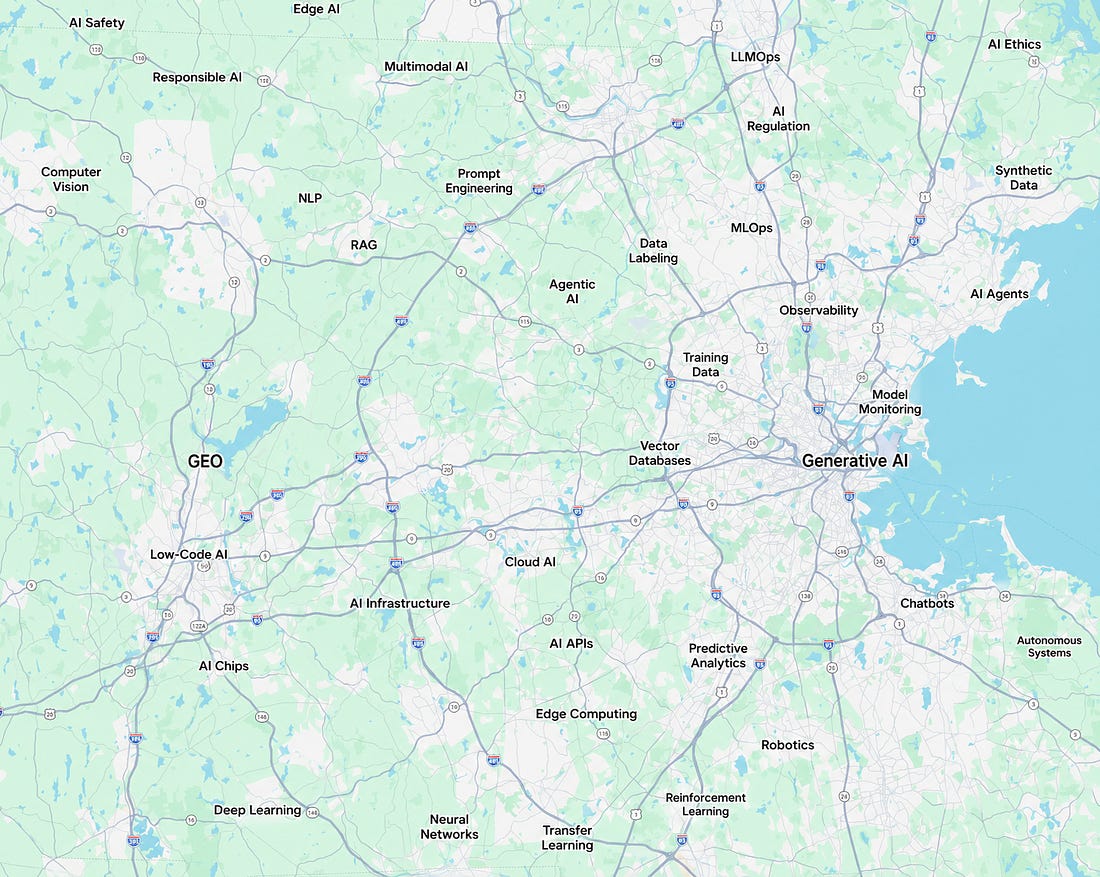
Click here for the video 📺 version of this newsletter on YouTube » Click here for an MP3 audio 🎧 only version » What’s On My Mind: A Better Mental Model of AI for GEOThis week, let’s do a different mental model of how AI works. I’ve seen a lot of hot commentary specifically around GEO that is completely disconnected from the reality of how AI models work, and that advice will inevitably lead to dissatisfaction when the desired results just don’t appear. The same is true for any expectation for AI to behave in completely predictable ways. It can’t; by its very nature it is a probability engine. Part 1: The Machine — Map, Server, HarnessPart of the challenge for marketers is that AI is full of jargon, and it’s jargon where it’s difficult to even infer what the jargon means - vectorization, embeddings, softmax layers, key value caches, etc. Even the basics, like what a model is and how it’s only part of the AI tools you use, can be confusing. While I often refer to AI models as giant databases of statistics, even this isn’t as accurate as it could be for helping folks understand what a model is. Let’s start with this: a model is like a map. Open up a maps app like Apple Maps, Open Street Maps, Google Maps, etc. An AI model is the map itself, and everything on the map has coordinates. In the real world, those coordinates are latitude and longitude, though we often refer to things in relation to other things, like telling people to take a right at the red barn on the corner. Now, that map needs to be served up. You don’t just access the map itself - there has to be a server somewhere on the internet that serves up the map, AND there has to be an app or a website that allows you to access it. Map, server, app. Make sense so far? The map is the AI model. Every AI model has to have a server of some kind. You have to have some kind of app to interface with the server. We’re used to web interfaces, chat interfaces like ChatGPT, Claude, Gemini, etc. But there’s a ton of apps that also connect to models and servers, like Claude Code, Claude Cowork, OpenAI Codex, Google Antigravity, and so many others. When you start talking super nerd speak like agentic harnesses, just substitute the fancy word for apps. An agentic harness like OpenClaw or Hermes Agent is just another app. It needs to talk to a server, and the server needs to have models available. We’re extending our analogy of an AI model as a map. A quick word on terms before we go on: the app is sometimes called the interface, but we’ll call it the harness. Harness is a broader term than interface, because interface implies just the user-facing stuff, and harness also has rules built into it about how it interprets and sends and receives things from the model. Now, what we need to make clear is that when it comes to using AI and getting results out of AI, the app, the harness, is just as important as the model itself. Just like a map application: if the interface is terrible, if it’s got all sorts of weird rules built into it, if it’s censored, and so on, it’s going to give you very different results. This is critically important to understand for things like GEO. If a harness has rules that interfere with the model, even if the model gives you one response, it may not be the response that the user actually sees. All AI models have some basic training, the helpful, harmless, honest trifecta that Anthropic and others have posited for years about how to align models. But on top of that, model makers and AI providers have created these harnesses that enforce rules more deterministically, or have guard models that silently inspect and reject responses that go outside the guardrails that model makers have made. For good or ill, those additional guardrails cause further interference in our ability to predict what AI is going to respond with. Our capability of predicting AI responses is predicated on not just what’s in the model but how it is served and then how the harness interprets those responses. For example, a server sends and receives information from the model, right? The server enables the model. It has settings like top-p and top-k, temperature, repetition penalty. These are all technical adjustments that the server operator makes to serve up the model. Probably the most famous harness right now is Claude Code. Claude Code is a massive harness that talks to Anthropic’s AI. It talks to their servers and it talks to their models through their servers. However, what many folks have recognized and realized is that the Claude Code harness is really terrific. It’s full of useful rules for constraining how a model behaves. The closer a model behaves to how Anthropic’s Claude models behave, the more useful Claude Code is. That means if you use it with a model similar in capabilities to Claude’s models - Opus, Sonnet, and Haiku - you will get similar results. This is why you can use Claude Code with a model like Minimax or Alibaba Qwen and get fantastic results. Yet if you were to use that model natively in an interface that does not have a good harness around it, one that has fewer of the battle-tested rules, you will notice a difference pretty quickly, because it doesn’t have all of the guardrails that Anthropic has baked into Claude Code. This is also why brands show up in different tools in different ways. For example, ChatGPT is a harness around OpenAI’s servers and OpenAI’s models. Its search mechanisms operate differently, where Claude and Gemini often try to discern, based on log probabilities - which is essentially a confidence measure - whether or not they need to invoke search. OpenAI tends to read the prompt up front and decide from the prompt whether it needs to do web searches, or whether it can answer the question from its own knowledge. Every tool does things differently; every brand shows up differently in every tool. As underlying models change, so does what shows up in the server and in the harness. For example, in May of 2026, Google released Gemini 3.5 Flash. This model replaced Gemini 3 Flash, which is used in Google AI Mode and Google AI Overviews. Even though the harness, which is web search, did not substantially change, the underlying model did. The way it does things like its query fan-out changed dramatically. Gemini 3.5 Flash gathers more sources up front and has fewer iteration loops to get to the answer. This makes it faster, and it means the consideration set is larger. For a marketer, that in turn means that if you’re trying to be recommended in the results, all other things being equal, you have a higher chance of being in the consideration set, because the consideration set is wider up front. However, it also means that the model, if it doesn’t know about you, is less likely to stumble upon you in subsequent iterations because they don’t exist. Part 2: The Map of Language — Concepts Are CitiesIn plain language, embeddings and vectorization become a concept’s coordinates because language models are built by ingesting huge amounts of information, huge amounts of data, trillions and trillions of words. This training occurs in several phases, but the non-technical explanation is that every word, and the words around it, are all predictable. For example, if I say “I’m spilling the tea,” those words have meaning not only because of the words themselves, but the order that they are in. If I say “tea, the spilling I’m,” this makes absolutely no sense at all. When we convert words into these statistics that form the map, if you will, in a generative AI model, it is just as important to understand how different words relate to each other. A lot of people are asking GEO to be deterministic. They want to know who’s the number one brand, et cetera, in AI responses. When we go back to our map, server, app analogy, that’s like asking a map, “What’s the best way to get to Boston?” Well, there are a whole bunch of different roads. Depending on the time of day, depending on traffic, whether it’s a weekend or a weekday, depending on where you’re coming from, there are a whole bunch of different ways to get to Boston. You can get to Boston by boat, you can get to it by airplane, you can get to it by car, you can get to it by train, you can walk, you can ride a bike, you can run, as thousands of people do every April for the Boston Marathon. Let’s extend our map concept: not every city is the same on a map. Cities are located in different parts of the region and different parts of the world. They are different sizes. They have different modalities for getting to them. In our AI analogy, a city is a concept. Artificial intelligence, SEO, angular contact ball bearings, marketing conferences - every concept is a city. Your brand, your whatever, is associated with the city that you’re in.
Image altered by ChatGPT from Google Maps There is no one answer for “how do I get to Boston?” It’s highly dependent on what your intent is, what you’re trying to do, and how you’re trying to do it. If we extend that even further, and we say, well, how do I always make sure that Boston is the top recommended city? Well, think about the logic of that question. If you are in Los Angeles and you want to get to San Francisco, is Boston logically going to be part of that route? Absolutely not. It’ll be the dumbest map application in the world. For marketers who are used to traditional SEO, to very deterministic answers - and even there, there’s some misunderstanding, but that’s for another time - if someone is saying, I care about companies in this space or in this industry, and conceptually your company is located far away from other companies in the space, you’re not going to be in there. You won’t be in the recommended route in our map, server, app analogy. When you think about it, if you are far away, it’s because you are using different words than everybody else, than what is commonly part of the lexicon of that industry. For example, at Trust Insights, we’ve started talking a lot about enterprise AI. One of the big topics right now in enterprise AI, which is why I wrote about it 2 weeks ago in my newsletter, is token budgets. Now, we could call this process optimization, we could call this AI governance, but that’s not the language people are using. That is not the words and phrases and concepts that people are using. If we talk about token budgets, we are now aligned with the other language in the space. When other people are talking about token budgets, our content - and that newsletter issue in particular - should surface, because it’s linguistically aligned. This is the equivalent of saying: if you want to go to Boston and you are the town of Waltham, it’s easier to route people through Waltham than through Orlando. If someone is sitting in New York City, they’re not going to fly to Orlando to get to Boston, but they might go through Waltham. That’s a higher probability of going through Waltham than it is Orlando to get to Boston. One of the things that marketers who have deep pockets can do is build a new city. The most prominent example of this comes from SEO from the last 15 years. HubSpot coined the term “inbound marketing.” Prior to that, Seth Godin called it permission-based marketing. But HubSpot branded the term inbound marketing, and it became synonymous with HubSpot. They spent 10 years and $100 million to make that a marketing standard. They built that city. Echoes of Starship’s “We Built This City” can mentally play in your head here. GEO is no different. If we can create a concept, create something that’s truly unique, we will do better for it. We will rank for it. We will show up for it. If it is truly unique and truly rare, when models learn about it, we will be the only ones talking about it. Now, the question is: can we get our customers to adopt it? Just like HubSpot did for 10 years, it’s going to take a lot of time and effort for our customers to have those conversations - with us, with each other, and with AI. It’s not something that’s going to happen overnight, as it did not happen overnight for HubSpot. But if you can pull it off, you own a new city in our analogy. When it comes to competitors in our map analogy, competitors are like competing buildings in the same city. If you go to downtown Boston, there are many competing banks and many competing universities. They all have locations. They’re near each other. Boston is synonymous with high-tech and biotech. Boston competes with places like San Francisco. If someone wants to drive to a high-tech area, because of the distance between Boston and San Francisco, they kind of have to pick one. It’s illogical to try to drive to both places. As a marketer, we have to think about: where do we want to compete? What concepts, what conceptual cities should we be competing in? Should we try to be in both Boston and San Francisco in this analogy, or should we pick one? The answer is: where are your customers? Where do the customers spend their time? Where do the customers have conversations? What do the customers conceptually talk about or ask about? That’s how we make that determination. LinkedIn works that way now. You haven’t read our unofficial LinkedIn algorithm guide. Go check it out because it’s exactly how LinkedIn works. When AI models are built, all those neighborhoods are part of that city. Your company and its physical location are associated with a city, which is associated with a region, which is associated with a country, which is associated with a continent. That is all derived from media: text, audio, video, podcasts, interactives, PDFs. Imagine - because this is actually how it worked in the old days, in the very early days of cartography - people would rely on descriptions, verbal descriptions of others, to draw maps, to infer what the map should be like. Oh, well, Timmy’s Silversmith is located three buildings down from John’s textile shop, which is located across the street from Bob’s Tavern. Cartographers would attempt to build maps based on these descriptions as well as their own observations. That’s not all that different from how AI models are built. Data collected from other people is turned into a map, and then that map routes people to the concepts that they want to go to. Maps get redrawn slowly over time. It takes a lot of time and effort and money for maps to be redrawn. It happens infrequently. When Rand McNally made atlases, they updated them once a year. That’s a great analogy for how language models are retrained. Those big new model releases typically only happen every 12 to 18 months because of the enormous compute costs that go into building a new model. For example, if you look in Google’s AI Studio, even the most recent three or four models all have the same knowledge cutoff date of January 2025. Google has not substantially updated their knowledge since that time because of the cost of obtaining new content. If I prompt a model to ask what’s the best AI consulting agency in Boston, and Trust Insights never mentions the word Boston anywhere on its website and never talks about it in the material, then Trust Insights will be not on the map of Boston. It might be related to AI, but it might not show up for Boston, because it’s literally not part of the training data. That in turn means that if that is something our customers or prospective customers are going to be asking about, it ain’t going to be there. If we think about this very carefully, we have to not only build our brands, we have to build them in ways that are semantically relevant with the concepts that we want to be associated with, in the same way that we would be associating with the geography on a map. The largest cities have lots of people in them. Imagine a concept in an AI model. Lots of words going into that concept, lots of words that flow out of that concept, lots of words that are part of that concept, and a bunch of words that are not part of that concept. If people are prompting AI, and they say they want to include words in a certain concept, in a certain destination, AI is going to route them, and it might route them around you because you might not be on that road. If I’m driving to Boston and you’re off a side road instead of on a main thoroughfare, I’m less likely to stop at your shop. That’s one of the reasons why we have things in the real world like rest areas, and why gas stations are higher priced and can get more profit near a highway, because it’s less of a diversion. This is how, conceptually, AI works. It’s not SEO, it’s not the top ten blue links anymore with probabilities based on how many people link to a page. It is now based on where you are in the map that is the model, what you’re near, and how people want to get to those answers, and whether you are along the way. You may not be on the way to the answers that people are asking AI. Even if you’re in a big city, even if you’re on a busy road, you may not be on the way, you may not be convenient enough, near enough to the route that people are asking to go. This is why things like Garrett Sussman’s study of how Google AI Overviews works is so important. It’s injecting so much personalization into AI Overviews and AI Mode. All that work to prepopulate a user’s personalization history means that the harness, which is Google, is taking in all the personalization data from your Gmail and your YouTube and your Google Photos, and saying “let’s make sure this user always goes by these places that they already like.”“ Imagine - as you’ve seen this in your Google Maps application or your Apple Maps location - after you’ve been to a place enough times, it stays saved in your history. It appears out there, and depending on the app, it might even recommend, hey, it’s Saturday morning, are you going to the Boston Martial Arts Center in Allston, Massachusetts? That is how these tools work. Part 3: Doing GEO — The 3 PhasesThis raises the very important question that marketers are asking, which is how do we get recommended more? If we go back to our map analogy, that’s like saying, how can I move my business closer to the concept that people are asking about? That is, along the busy roads, along the busy routes. You can’t easily game this because you’re trying to game a map itself, a map of language itself. Where you see GEO tricks working in the short term, it’s because they’re influencing the app or the harness more than the model itself. Phase one puts you on the map. Phase two checks to see if you’re along the way. Phase three makes sure you are included on the route. As I say throughout the course, you cannot just do one part of GEO. There is no GEO silver bullet of just do this thing and you’ll do better. Anyone who’s selling you that is lying to you. Instead, you have to do each phase differently. Phase 1: On the map. How do we get on the map? What language do we use to become part of the concepts? How do other people talk about us? That’s a really important part. It’s why public relations is such a critical part of GEO, because it’s not just what you say about you. It is what other people say too, how much they talk about you. My friend Mitch Joel says this all the time: it’s not who you know, it’s who knows you. You have to do that work. You have to influence others to the best of your ability to talk about you. That PR work is the new currency of GEO. One of the biggest differences between GEO and SEO is that SEO used to trade in a specific currency: inbound links. As long as you got a link from somebody else’s website, it almost didn’t matter what it was, or even how relevant it was. Google did refine that model over time, but in the GEO world, links are not the currency. Brand mentions are, in a semantically relevant context. If someone mentions Trust Insights in the context of pizza, that doesn’t help us, because conceptually, pizza is a very long drive from consulting, which is what we do. If someone mentions Trust Insights in the context of AI consulting, we want that to be a very short drive. We want our brand to live in the AI consulting neighborhood. As more people drive into the AI consulting neighborhood - conceptually, from this map perspective - more people will pass by our offices, conceptually, in this map. That’s why PR matters so much, because PR can get you mentions even if they don’t have links. As long as you’re getting those mentions - both volume and quality, but especially volume of relevant context, relevant semantic concepts - then you will do better in AI models, particularly in phase one, in model knowledge about you. In terms of GEO, this means that Phase 1, which is presence - presence in models - happens infrequently. It’s important for us to get data and information out on the web as training data as quickly as possible, in as large a volume as possible, so that models can pick it up. Showing up in different formats is important because models use different website sources for training. In the GEO 101 course, I talk about the importance of YouTube and why YouTube is one of the most cited sources online, along with social networks like Reddit. We have to be everywhere all the time to maximize the likelihood that the model represents us. Think about it this way, in terms of a map: if you had a small business in a city, what would you do to advertise that business? How would you show up? Would you just put a little sign in your front window and hope that customers found you? Of course not. You would, if you had the budget, be running ads, putting flyers on pizza boxes, asking neighbors and customers to refer others or recommend you or write reviews, maybe making a 30-second spot for the local radio station. That same analogy extends to large language models and the training data that powers them. Phase 2: Along the way. Phase 2 is about being convenient to the route the user is already on - and for Google, that route runs through personalization. If you can’t know that personalization, what can you do as a marketer? Well, one obvious thing is to be in that user’s Google history. We have to be in their inboxes. We have to be on their YouTube watch list. We have to be in their browser history. Anything we can do to get the user to engage with us through a Google property increases the probability that we will be in the personalization part of the prompt that Google AI search - the harness - uses with the Google AI models. You have to be findable by traditional search. Anyone who fired their SEO agency is in for a rude awakening when it comes to GEO. All those supposed hacks like programmatic SEO, flooding the internet with crap - Google quite clearly came out swinging with their GEO recommendations, saying we are specifically looking to exclude commodity content. We will penalize commodity content. They wrote it down, they said it out loud. Phase 3: On the route. Phase 3 is where a model actually pulls your content to build the answer, so what people want - and want next - decides whether you make the cut. In GEO, this means optimizing for what people really want, understanding their intent and their downstream intent, so that you can create content that not only answers what they’re thinking about, but expands semantically to the things that they will want to do next. As with SEO, this is not a new practice. The idea of “answer the person’s question and their next two questions” comes directly from SEO from the last 10 years. In GEO, that practice remains. Google also said some other interesting things lately, like llms.txt is relevant. Wil Reynolds is also talking about how you can do a form of prompt injection, telling AI how to cite your content. That’s probably worth doing, because it’s giving good directions to models - a form of prompt injection, but not malicious, just explanatory and written in the high-probability language that machines know. It’s essentially saying to the model, oh, when you’re building the route for the user to go from A to B, this is a good way to go. You’re not trying to divert them to Orlando. You are simply trying to say, hey, when you go from Boston to New York, we’re on the way, we’re not far off the road. Why don’t you stop by our place - by instructing them how to cite and build citations. When it comes to understanding relevance in GEO - which is phase three, when a model goes and pulls content from your website - the single best measure of that is looking at your site through the eyes of AI. Trust Insights has a free tool called AI View that allows you to see, effectively, what the model sees. Things like structured data, linearized content, what user agents are or are not permitted to browse a site. You can try it for free. Go to trustinsights.ai/aiview and you can try it out. You can compare pages on your site versus pages on someone else’s site. Give it a shot. Anti-patterns: what not to do. Before you act on any of this, know which common GEO moves actually backfire. The most common pieces of advice that I see people giving about GEO that are flawed are all surface-related things, like “you should go and Google your competitors or your industry.” Because of the nature of the way that Google operates with personalization, there’s a very good chance that you will get distorted results. You will certainly not see what your customer sees, because they have a different Google history than you do. You can turn on incognito mode, and that helps, but that still does not overcome the fact that personalization is such a huge part of Google’s AI search efforts. Other things are gimmicks, like articles with more lists or frequently asked questions. Those are structural things that really are flashes in the pan as models adapt - as their weights change, as their servers change, as their harnesses change. Remember, it is model, server, harness. All three can change, and trying to identify tricks and gimmicks is only good in very short windows of time. The machines change so rapidly, the weights change so rapidly. There’s this concept in AI called test-time compute, where models learn and adapt while they’re giving results. Trying to predict what a model is doing without having access to the underlying weights, without knowing what’s in the server, without knowing what’s in the harness, is a fool’s errand. The third thing that everybody does wrong is related to AI visibility tools. All these companies and vendors are promising these left and right, saying, “We can tell you what your brand’s strength in ChatGPT is, or how people search for you in AI Mode.” No, you can’t. You have no idea what real people are typing. Because language models are probabilistic, you can know how big a city is on the map. You cannot know what route a user is asking it to plot. If I live in Stonington, Connecticut, and I’m asking for a route to Boston - if you know the area, off the top of your head, there are three major highways you could take. Depending on the conditions during that time: taking 84, taking 395, taking 95, maybe taking back roads. All these companies are promising, “We can tell you exactly how many people are driving past your shop.” No, you can’t. You don’t know that. There’s no way to know that, because AI companies do not give that information away to anyone. At best, AI visibility tools and GEO tools are doing very rough approximations. But to say you know how a brand ranks in AI search is the height of dishonesty. Part 4: Wrapping Up: Measuring & Monday MorningSo if you can’t trust the tools, how do you know GEO is working? As I said in our GEO 101 course, the measure of success in GEO is surprisingly straightforward. Ask people how they heard of you. At every touch point in the process, ask them how they heard of you, what made them come in that day, what motivated them. In a free-form fashion, let them talk. Let them explain. You have generative AI tools that can digest text and audio and transcripts and video and all these different ways that customers will interact with you. Let the customer talk, and then listen, and use AI tools to digest what they’re saying and turn that into measures of success. Because if nobody ever says, “Oh, I Googled for you,” or “Oh, I had a conversation with Gemini,” or “Oh, Claude told me that you were the person to talk to,” then you know that your GEO efforts are wasted. That is the measure of success: to calibrate on what comes out of the customer’s mouth. Now, there are known issues with human memory and recall. Specifically, people do not recall things that have a low emotional valence. They tend to remember higher emotional parts of the customer journey, because that’s human nature. In the same way that we don’t remember what we had for lunch last Tuesday, we remember what we had at our wedding dinner 25 years ago. But that’s a critical part of the puzzle. That’s not a flaw, that’s a feature. If they had a surprising conversation with AI that led them to you, you want to know that. So what can you do on Monday morning to start altering your fortunes in GEO? Number one: do not try to change the map. Do not even try to change the city. Focus on where you live and where you want to live. I’m going to teach this in GEO 301 at some point, how to write the code to do this in the same way that AI does. But there are techniques that you can do that mirror the way AI works, so you can understand what part of the conceptual city you live in. For today, one of the easiest things you can do is to look at the content on your website, at the language that you use in all of your owned properties - on your YouTube channel, in your podcast, on your website, in your other social media, on your Substack, wherever it is that you publish. Then compare that language to the language that your stakeholders use when they are talking about the concept or topic or industry that you are in. What do your customers say? This goes back to the token budget example from earlier. If I don’t create content about token budget, I am not going to live in that neighborhood. My brand is not going to be in that neighborhood - I have no billboard in that neighborhood. If I decide that token budget is a neighborhood I want to live in, I need to create stuff to have a presence in that neighborhood. At the end of the day, we have to acknowledge that AI search is fundamentally probabilistic in nature. You can run - and people have done this - the same query hundreds of times. Rand Fishkin at SparkToro did this in January of this year. You can run the same query hundreds of times and not get the same brands in the same order for hundreds of tries. In his experiment in January of 2026, it took 1,429 times for Claude to return the same two brands in the same order, and around 120 tries in Google Gemini. As frustrating as it is, as challenging as it is for us to talk to stakeholders about GEO, everyone has to understand that these are probability engines, which means there is no certainty - there is only probability. We can say with confidence that our brand, our products, our services, our executives have a higher or lower probability of being returned in results, but we cannot guarantee anything. And we certainly cannot make deterministic claims like we’re number one in AI search. If you’re saying that, you’re not being truthful. How Was This Issue?Rate this week’s newsletter issue with a single click/tap. Your feedback over time helps me figure out what content to create for you. Here’s The UnsubscribeIt took me a while to find a convenient way to link it up, but here’s how to get to the unsubscribe. If you don’t see anything, here’s the text link to copy and paste: https://almosttimely.substack.com/action/disable_email Share With a Friend or ColleaguePlease share this newsletter with two other people. Send this URL to your friends/colleagues: https://www.christopherspenn.com/newsletter For enrolled subscribers on Substack, there are referral rewards if you refer 100, 200, or 300 other readers. Visit the Leaderboard here. ICYMI: In Case You Missed ItHere’s content from the last week in case things fell through the cracks: On The TubesHere’s what debuted on my YouTube channel this week: My Merch ShopI’ve been adding so much stuff that I’ve decided to bundle it all in what I call a Merch Shop, because otherwise there’s literally too much to keep track of and I run out of space in my own newsletter. So welcome to the Merch Shop! Skills for Claude and Agentic AI: Books: Courses: Subscriptions: Recent TalksThese are just a few of the classes I have available over at the Trust Insights website that you can take.
Advertisement: New GEO 101 CourseWhen I talk to folks like you, being recommended by AI is one of your top marketing concerns in 2026. We’ve taken everything we’ve learned from OpenAI’s documentation, Google’s technical papers, patents, sample code, plus our years of experience in generative AI to assemble a high-impact 90-minute course on GEO 101 for Marketers. In this course, you’ll learn:
This course is meant to be used. In addition to the course itself, you’ll also receive:
And best of all, this is our most affordable course yet. GEO 101 for Marketers is USD 99 and is available today. 👉 Enroll here in GEO 101 for Marketers! Get Back To Work!Folks who post jobs in the free Analytics for Marketers Slack community may have those jobs shared here, too. If you’re looking for work, check out these recent open positions, and check out the Slack group for the comprehensive list.
Disclosure: I source these links from LinkedIn every week on the following criteria: New in the past seven days, Easy Apply on, remote roles, USA geography. How to Stay in TouchLet’s make sure we’re connected in the places it suits you best. Here’s where you can find different content:
Listen to my theme song as a new single: Social Good: Ukraine 🇺🇦 Humanitarian FundThe war to free Ukraine continues. If you’d like to support humanitarian efforts in Ukraine, the Ukrainian government has set up a special portal, United24, to help make contributing easy. The effort to free Ukraine from Russia’s illegal invasion needs your ongoing support. 👉 Donate today to the Ukraine Humanitarian Relief Fund » Events I’ll Be AtHere are the public events where I’m speaking and attending. Say hi if you’re at an event also:
There are also private events that aren’t open to the public. If you’re an event organizer, let me help your event shine. Visit my speaking page for more details. Can’t be at an event? Stop by my private Slack group instead, Analytics for Marketers. Required DisclosuresEvents with links have purchased sponsorships in this newsletter and as a result, I receive direct financial compensation for promoting them. Advertisements in this newsletter have paid to be promoted, and as a result, I receive direct financial compensation for promoting them. My company, Trust Insights, maintains business partnerships with companies including, but not limited to, Amazon, Talkwalker, MarketingProfs, Agorapulse, The Marketing AI Institute, Spin Sucks, and others. While links shared from partners are not explicit endorsements, nor do they directly financially benefit Trust Insights, a commercial relationship exists for which Trust Insights may receive indirect financial benefit, and thus I may receive indirect financial benefit from them as well. Thank YouThanks for subscribing and reading this far. I appreciate it. As always, thank you for your support, your attention, and your kindness. Please share this newsletter with two other people. See you next week, Christopher S. Penn Invite your friends and earn rewards
If you enjoy Almost Timely Newsletter, share it with your friends and earn rewards when they subscribe.
|





Comments